In 2006, New York City signed contracts for private-public partnerships that would deliver a variety of street furniture throughout the city. To date, 3,355 bus shelters, 304 newsstands, and three (3) public toilets have been built.


Sam Roberts reports on the slow pace at which a Spanish company called Cemusa, working with the Department of Transportation, has been able to site and install public toilets in New York City.
Here is what has sufficed for progress so far: “The first toilet was installed in Madison Square Park early in 2008, followed by one in Corona, Queens, later that year. The third was placed in Grand Army Plaza, Brooklyn, in 2011.”
“If installation continues at this rate, the 20 automatic toilets for which the city sought bids fully a decade ago will be functioning by about 2065. Of course, even 20 toilets, for a city that swells to nearly 10 million with commuters on a typical weekday, would mean one such facility would serve nearly 500,000 people,” writes Roberts.
As for why it’s been so difficult to install public toilets, despite popular demand: “a number of neighborhoods have responded to the toilets with a not-in-my-backyard indifference, at best,” and “no lavatory lobby has ever materialized.”
Some in New York expected these problems from the outset, and other cities have also found public toilet programs difficult to implement and expensive, at best.
Read the full story: In 9 Years of Work, Just 3 Public Toilets Go Live

See Downtown Brooklyn’s Dramatic Complete Streets Transformation
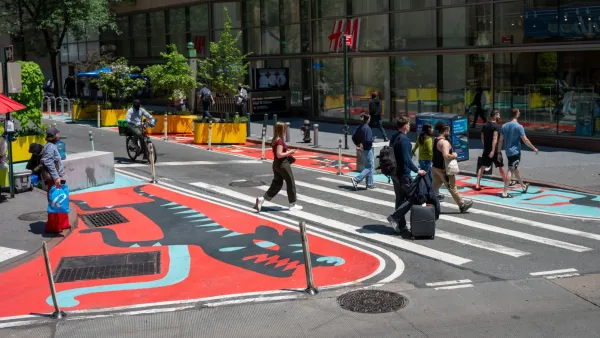
A streetscape redesign spearheaded by the Downtown Brooklyn Partnership has quickly made many of Brooklyn’s streets unrecognizable.

New York City Parks Getting Modular Public Bathrooms
The ‘Portland Loo,’ named after its birth city, is designed to withstand year-round weather and resist vandalism.

A New Strategy for Attracting Big City Millennials: Build Ax-Throwing Bars
Two New Jersey suburbs of New York City are taking an interesting approach to attracting New York City Millennials looking for refuge from the high cost of rent in the Big Apple.

Planetizen Federal Action Tracker
A weekly monitor of how Trump’s orders and actions are impacting planners and planning in America.

Amtrak, CN end decades-long dispute with eight-year agreement
The new operating agreement establishes an updated framework for the companies to work together, including processes to resolve disputes.

Judges permit Denver to divert 77,000 acre feet from the Colorado River for reservoir expansion
Overuse and climate change have caused the Colorado River’s water levels to plummet.

NYC DOT wants faster, more permanent street upgrades
The city is examining ways to build more concrete infrastructure without getting entangled in 'decades-long' projects.

'Something we’ve never seen before:' rising utility rates could strain city finances nationwide
Data centers, climate change and other factors have caused utility rates in the United States to increase by 38% since 2020.

Trump to overrule local leaders, lease millions of acres of America’s Pacific Island territories’ seafloors to mining companies
International law says that the Indigenous people of America’s territories have a right to prior and informed consent regarding projects that impact their countries.

FREE Course: Walkable City 1: Why Walkability?
After describing his path towards focusing on walkability as the essence of good planning, Jeff Speck marches through his five principal reasons for making more walkable places.
Reinventing Malls: Planning Alchemy—Turning Gray Fields Into Gold
The course focuses on the opportunities and imperatives that shape reinvention of mall sites.

Harvard University Graduate School of Design
KFH Group Inc.
Greater Baltimore Committee
The Architects Foundation
University of Cincinnati Online
The Pocatello Development Authority
The Urban Renewal Agency of the City of Pocatello