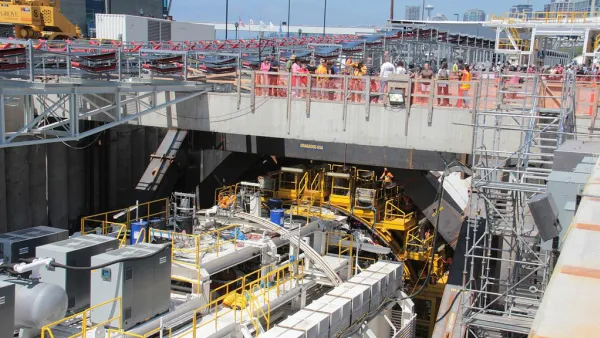
Though Seattle's giant tunneling machine remains stuck 60 feet under South Main Street, muck is starting to be flung above the surface. An email from Washington's Transportation Secretary reveals concerns over the conduct of the machine's operators.


As the mystery behind what's blocking Seattle's tunnel-boring behemoth remains unsolved more than 6 weeks after digging was halted in the area beneath Pioneer Square, questions are being raised about contractor Seattle Tunnel Partners' (STP) operations in the months prior to the work stoppage. "State Transportation Secretary Lynn Peterson says the agency 'has had concerns' about how contractors have been operating tunnel-boring machine Bertha since July 30, when drilling began," reports Mike Lindblom.
In an email sent last week to state lawmakers, Peterson remarked that:
WSDOT has had concerns about the machine’s operations and critical systems since its launch on July 30, 2013. We have discussed these concerns with STP frequently over the past five months and this week sent a formal letter stating our concerns and asking STP how they will address them prior to tunneling under the viaduct and downtown. We are providing you [elected officials] with this information in lieu of a copy of the letter because it could be the subject of a potential future litigation between WSDOT and the contractor.
"Chris Dixon, project director for STP, didn’t comment Wednesday on Peterson’s message," notes Lindblom. "But earlier Wednesday, he said the contractors think something in the soil, as opposed to mechanical trouble, is to blame for the stall." Reports earlier this month suggested that an eight-inch metal pipe was responsible for the stoppage.
FULL STORY: State questions Bertha strategy, sees ‘potential future litigation’

Bertha Stuck Again: Sinkhole Prompts Suspension of Highway 99 Tunnel Project
The adventure of Bertha the tunnel-boring machine, already two years behind schedule, has a new twist.
Bertha Awakens—New Hope After a Two-Year Delay for Seattle Tunnel-Boring Machine
Baby steps are an improvement for the tunnel-boring machine known as Bertha. The drill moved a total of 1.5 feet this week, but the symbolic distance probably felt like a mile.
What's Blocking Seattle's Tunnel-Boring Behemoth?
Is it a giant rock? What about a sunken ship? Beneath Seattle's waterfront, a mysterious object has halted Bertha, the world's largest tunnel-boring machine. Stumped engineers are unclear on how long a highway tunneling project will be suspended.

The state-sanctioned urbicide of Austin
People don’t kill cities. Freeways do.

US to reduce Colorado River water deliveries to Mexico
A new Colorado Treaty amendment reduces Mexico’s Colorado River water allocation by 250,000 acre feet.

New Jersey’s second-largest city bans standalone data centers
Jersey City will continue to allow co-location facilities, such as those meant for research institutions that store their own data.

Amtrak not solely to blame for New Jersey commuter rail's unreliability, report finds
A new study from the Garden State Initiative found that NJ Transit’s budget grew 20% across a 4 year period, but reliability declined significantly over the same period.

EPA erases limits on planet-warming pollution from power plants
Under Monday’s plan, power plants would still have some limits on how much mercury, arsenic and other contaminants they can emit.

Phoenix announces new on-demand transit service, more frequent RAPID buses
Both new services will launch in October, and are part of Phoenix's Project Effective Access Solutions for Easing Congestion.

FREE Course: Walkable City 1: Why Walkability?
After describing his path towards focusing on walkability as the essence of good planning, Jeff Speck marches through his five principal reasons for making more walkable places.
Reinventing Malls: Planning Alchemy—Turning Gray Fields Into Gold
The course focuses on the opportunities and imperatives that shape reinvention of mall sites.

Eagle County Government
Harvard University Graduate School of Design
Nashville Planning Department
The Architects Foundation
University of Cincinnati Online
The Pocatello Development Authority
The Urban Renewal Agency of the City of Pocatello
Journal of the American Planning Association