A fascinating new study found that drivers perceive exactly the same things more negatively than those who walk, bike, or take transit. These findings have a few interesting implications.



A fascinating new study has revealed what many Planetizen readers already know: cities aren't meant to be experienced from behind the wheel of a car. Researchers at the University of Surrey found that drivers perceive exactly the same things more negatively than those who walk, bike, or take transit, confirming the anecdotal experience of literally every person that's ever tried to find parking in an urban downtown.

Photo: WPIQ Radio
Pacific Standard Magazine has a great write-up describing the results of the study, in which participants were asked to judge the traits of people they saw from a car, transit, bicyclist, or pedestrian perspective:
The researchers found that participants who saw the video from the perspective of a car rated the actors higher on negative characteristics (threatening, unpleasant) than participants in the other three conditions. Participants who saw the video from the perspective of the pedestrian rated the actors higher on positive characteristics (considerate, well-educated) than those in the car condition.
These findings have a few interesting implications. For example, they may help explain the "war on cars" furor of the past several years. It's easy to imagine how some individuals, so married to their windshield perspective, could see any attempt to improve active or public transportation as a direct attack on their person. Those people on the street are so threatening and unpleasant, after all. Why should the city cater to people like that? Transit and active transportation advocates, meanwhile, are baffled by the vitriol of the Dorothy Rabinowitzes of the world because the streetside perception of our changing cities has generally been positive.
The PS Mag article also asks readers to consider the experiences of a rural visitor to the city, compared to a resident. My personal experience reflects both of these perspectives. I grew up in the suburbs and hated visiting nearby Seattle: traffic was a nightmare, finding parking was a chore, and the complexity of the city created a constant sense of anxiety and directionlessness for me. It wasn't until necessity demanded a move to Seattle, for school, that I came to recognize what cities had to offer and became the urban proponent that I am today. I had to experience the city at the ground level, as a pedestrian, bicyclist, and transit rider to truly appreciate it. But I have many long-time friends who remain wary of cities and are confident in their disinterest, and it's almost impossible to convince them otherwise as long as they're unwilling to immerse themselves as only residents can. I'm sure many urbanist readers can sympathize.
A related study compares perceptions of crime between urban and rural residents, and finds that although urban residents perceive their neighborhoods as less safe they nonetheless feel more comfortable within them. This reflects a few realities, I think, including the relative comfort that comes from dense populations — the "eyes on the street," described by Jane Jacobs, that help deter crime and the perception of personal threat. It also aligns with the message of an earlier article I wrote about cul-de-sacs, and how suburban and rural neighborhoods often seem to derive their sense of community from a kind of turf mentality, where strangers are unwelcome and invariably threatening. The diversity of cities necessitates an openness to and acceptance of others; this, in turn, allows residents to respond more flexibly to new experiences and uncertain circumstances. Those experiences can be recognized as interesting — a part of the unique appeal to urban life — rather than intimidating or scary.
These studies, taken together, indicate that cities working to emphasize walkable, transit-oriented communities are laying a strong foundation for continued growth. Improvements that focus on how people interact with cities at a human level, rather than the driving experience, are likely to be the changes that produce the most positive experiences for visitors and new residents. And the more alternatives residents and visitors have for getting around without a car, the fewer negative impressions they're likely to form of the city.

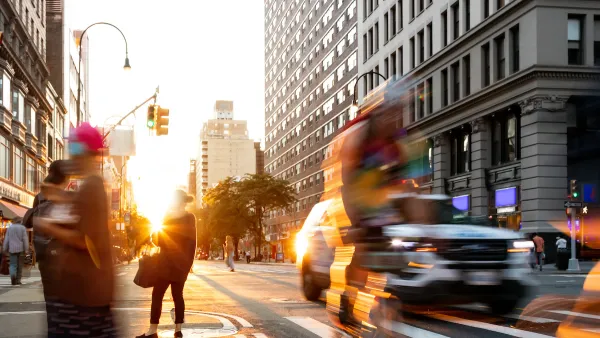
When it Comes to Transportation, It’s All About Options
Debunking the notion of the personal automobile as liberator.
Partisan Splits for Transportation Politics
Researchers found that while left-leaning respondents were more likely to favor transportation reform and sustainable modes, conservatives are not as far behind as we think.
Back-to-School Traffic Management Plan: Me Time
A humorous post offers advice on how to adjust to life trapped in a sea of cars swelled by school pick-up and drop-off schedules: think of it as "me time."

Planetizen Federal Action Tracker
A weekly monitor of how Trump’s orders and actions are impacting planners and planning in America.

Amtrak, CN end decades-long dispute with eight-year agreement
The new operating agreement establishes an updated framework for the companies to work together, including processes to resolve disputes.

Northwest rail fans eager for Sept. 30 debut of Amtrak’s Airo fleet
Get ready for that new train smell and more seats. But they won’t go faster or run more frequently on the Cascades route in Washington and Oregon.

Brightline Florida files for bankruptcy
The transit company is over $5 billion in debt.

St. Louis Metro to test if single-car trains can reduce operating costs, maintain rider satisfaction
The pilot program will run from October to spring 2027, and begin with one single-car train operating on Metrolink’s Red and Blue lines.

Pennsylvania is building data centers in abandoned mines
Housing data centers in mines provides an alternative to destroying local forests and may spare residents from data centers’ noise and air pollution.

FREE Course: Walkable City 1: Why Walkability?
After describing his path towards focusing on walkability as the essence of good planning, Jeff Speck marches through his five principal reasons for making more walkable places.
Reinventing Malls: Planning Alchemy—Turning Gray Fields Into Gold
The course focuses on the opportunities and imperatives that shape reinvention of mall sites.

City of Thousand Oaks
City of Wisconsin Rapids
Harvard University Graduate School of Design
The Architects Foundation
University of Cincinnati Online
The Pocatello Development Authority
The Urban Renewal Agency of the City of Pocatello

