The NYPD's failure to produce usable traffic crash data, or agree to change their data gathering and reporting procedures, is just one example of the obstacles confronting implementation of the city's landmark open data law.


"On Thursday, the [New York City Council's] Transportation Committee was discussing Intro 1163, a bill requiring the city's Department of Information Technology and Telecommunications (DOITT) to maintain an interactive traffic crash map," writes Kate Hinds. "This is data that street safety advocates, community board members, and some city council members have been pushing for for years, because it allows people to visualize data."
"But the NYPD, represented at the hearing by assistant commissioner of intergovernmental affairs Susan Petito, is opposed to the bill." According to Hinds, the reasons given for the opposition were many, but they essentially boiled down to one: "a philosophical objection by the Police Department to posting this sort of...crash data on a site".
NYPD isn't the only city department flouting the new law. The Departments of Transportation and Education were singled out by Code for America's Noel Hidalgo as particularly uncooperative in public testimony.
Read the full story: The NYPD's Crash Data Is Bad and There's Not Enough of It
Statistics Show NYPD Enforcing Vision Zero Pedestrian Safety Initiative
The law enforcement results are in from the first year of Vision Zero policy in New York City.
NYC Launches Major Traffic Safety Campaign
The new initiative from the city's Department of Transportation and Police Department will target speeding and failure-to-yield violations, including rogue cyclists.
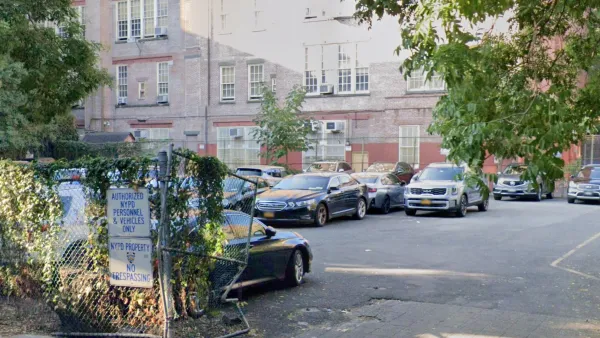
NYPD parking lot to become affordable housing as part of Mamdani's Block by Block initiative
The city awarded the lot to a group of developers to build a mixed-use project with 131 housing units.

Planetizen Federal Action Tracker
A weekly monitor of how Trump’s orders and actions are impacting planners and planning in America.

Eastern Nebraska is running out of electricity
Data centers and electrification are straining eastern Nebraska’s grid, throttling economic development.

Move over, LA: St. Louis gears up for Olympics, invests millions in downtown redevelopment
The Missouri city will host the 2028 Olympic soccer group stage and knockout matches.

Dallas releases zoning code overhaul to officials
The drafted overhaul is over 400 pages long.

NYC renovations for dangerous, ‘mercilessly crammed’ street delayed until 2027
Construction was supposed to begin this fall.

San Diego’s Midway Rising project gets greenlight from city council
The project looks to become the largest affordable housing development in California's history.

FREE Course: Walkable City 1: Why Walkability?
After describing his path towards focusing on walkability as the essence of good planning, Jeff Speck marches through his five principal reasons for making more walkable places.
Reinventing Malls: Planning Alchemy—Turning Gray Fields Into Gold
The course focuses on the opportunities and imperatives that shape reinvention of mall sites.

City of Rosemead
Rutgers University, Edward J. Bloustein School of Planning and Public Policy
One Hundred Miles
University of Michigan School for Environment and Sustainability (SEAS)
Hunter College, City University of New York (CUNY)
The Architects Foundation
City of Cambridge
The Pocatello Development Authority
The Urban Renewal Agency of the City of Pocatello