Mahatma Gandhi's utilization of non-violent civil disobedience to fight for civil rights is taught to school children around the world, but his views on the importance of biking and walking are less well known. Navdeep Asija investigates.


"Gandhi was [a] strong supporter of cycling and walking, who can perhaps be credited with starting the sustainable transport movement in India," writes Asija, the 2011 recipient of the National Award of Excellence from India’s Ministry of Urban Development. "In his book Hind Swaraj, he defined the principle of sustainability as, 'More from less for more'."
As Asija explains, walking and biking were an essential part of Gandhi's daily routine and both the method and subject of his protests. However, modern India has strayed from sustainable transport. "Today’s urban planning is dominated by motorized vehicles," he laments.
"It’s impossible to imagine what might have happened if had India followed Gandhi’s ideals on sustainable transport and urban planning from its founding, and given support to the local informal sector, which includes non-motorized transport," says Asija. "Although it’s sad to see that none of the principles given by Gandhi are currently being adopted into India’s transportation policies, it’s not too late to implement them."
Read the full story: Ahead of his time: Gandhi’s ideals on sustainable transport and urban planning

Partisan Splits for Transportation Politics
Researchers found that while left-leaning respondents were more likely to favor transportation reform and sustainable modes, conservatives are not as far behind as we think.
Making Climate Change a Priority for Transportation Planning
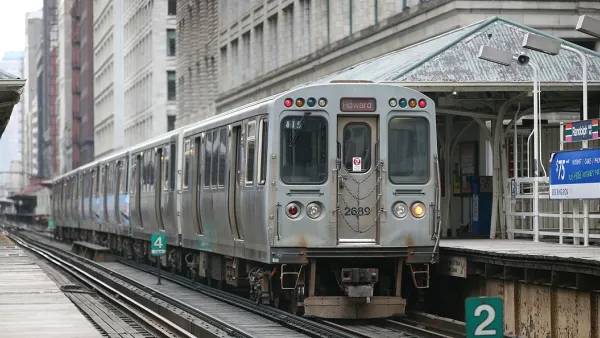
The threat of climate change has not guided transportation planning in Chicago, and the city and region could be doing much more to promote sustainable transportation, according to the article.

Pilot Project Offers E-Bike Rebates in New York State
The program will start in the Village of Ossining with plans to expand in the greater Hudson River region.

Planetizen Federal Action Tracker
A weekly monitor of how Trump’s orders and actions are impacting planners and planning in America.

California plans to bury El Niño’s downpour
If the state plays its cards right, it may be able to store a billion acre-feet of El Niño’s water in aquifers.

Desperate measures: Advocates weigh draining Lake Powell to fill Colorado River
Draining the reservoir could reduce evaporation losses by a couple hundred thousand acre-feet.

Voters across the country reject data centers
Dozens of communities voted on measures to restrict the buildout of data centers.

US buildings threatened, destroyed by fires set to triple by 2060
Researchers found a high fire risk for socioeconomically vulnerable neighborhoods in the American West.

LA residents may be allowed to paint their own crosswalks
Councilwoman Katy Yaroslavsky put out a motion instructing the Los Angeles Department of Public Transportation to study the feasibility of allowing volunteers to paint crosswalks.

FREE Course: Walkable City 1: Why Walkability?
After describing his path towards focusing on walkability as the essence of good planning, Jeff Speck marches through his five principal reasons for making more walkable places.
Reinventing Malls: Planning Alchemy—Turning Gray Fields Into Gold
The course focuses on the opportunities and imperatives that shape reinvention of mall sites.

City of Rosemead
Rutgers University, Edward J. Bloustein School of Planning and Public Policy
One Hundred Miles
Hunter College, City University of New York (CUNY)
The Architects Foundation
University of Cincinnati Online
City of Cambridge
Montrose County
The Pocatello Development Authority