A new study from the U.N. Food and Agriculture Organization found that the 1.3 billion tons of food wasted every year make it one of the largest sources of greenhouse gas emissions.


Reducing food waste can have myriad social, economic, and environmental benefits. But a new report has put a number to the impact on global warming that uneaten food has every year. "The world throws away one-third of food produced yearly, making food waste the third-largest source of greenhouse gas emissions behind those produced by the U.S. and China, according to a U.N. report released Wednesday," writes Ricardo Lopez. "[T]he U.N. estimated the carbon footprint of the problem is equivalent to 3.3 billion tons of carbon dioxide every year."
"All of us -- farmers and fishers, food processors and supermarkets, local and national governments, individual consumers -- must make changes at every link of the human food chain to prevent food wastage from happening in the first place, and re-use or recycle it when we can't," said FAO Director-General José Graziano da Silva.
Read the full story: One-third of food wasted worldwide harms environment, U.N. says

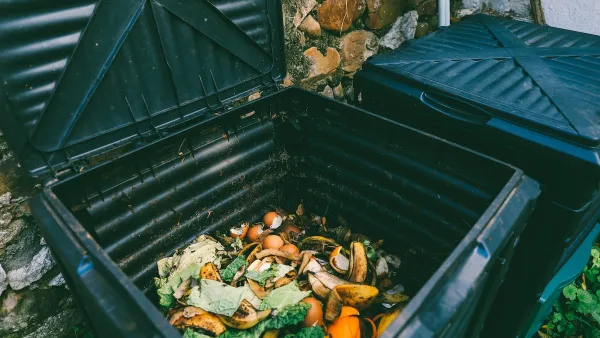
Massachusetts Has the Nation’s Only Successful Food Waste Ban
The state has reduced its methane emissions by 25.7 percent per ton of waste following a law that seeks to eliminate food waste from landfills.
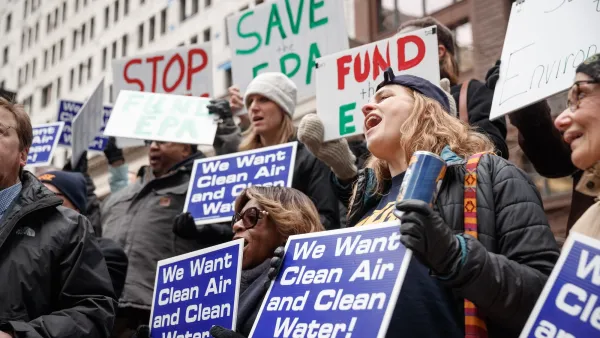
EPA Guts Emissions Regulations
The agency is eliminating the endangerment finding that underpins the agency’s authority to regulate greenhouse gas emissions.
FTA Kills ‘Social Cost of Carbon’ in Transit Grant Criteria
The Capital Investments Grant program will no longer factor in the future impacts of carbon emissions.

Planetizen Federal Action Tracker
A weekly monitor of how Trump’s orders and actions are impacting planners and planning in America.

Amtrak, CN end decades-long dispute with eight-year agreement
The new operating agreement establishes an updated framework for the companies to work together, including processes to resolve disputes.

Judges permit Denver to divert 77,000 acre feet from the Colorado River for reservoir expansion
Overuse and climate change have caused the Colorado River’s water levels to plummet.

NYC DOT wants faster, more permanent street upgrades
The city is examining ways to build more concrete infrastructure without getting entangled in 'decades-long' projects.

'Something we’ve never seen before:' rising utility rates could strain city finances nationwide
Data centers, climate change and other factors have caused utility rates in the United States to increase by 38% since 2020.

Trump to overrule local leaders, lease millions of acres of America’s Pacific Island territories’ seafloors to mining companies
International law says that the Indigenous people of America’s territories have a right to prior and informed consent regarding projects that impact their countries.

FREE Course: Walkable City 1: Why Walkability?
After describing his path towards focusing on walkability as the essence of good planning, Jeff Speck marches through his five principal reasons for making more walkable places.
Reinventing Malls: Planning Alchemy—Turning Gray Fields Into Gold
The course focuses on the opportunities and imperatives that shape reinvention of mall sites.

Harvard University Graduate School of Design
KFH Group Inc.
Greater Baltimore Committee
The Architects Foundation
University of Cincinnati Online
The Pocatello Development Authority
The Urban Renewal Agency of the City of Pocatello