Perhaps it's not surprising to learn that HOT lane usage increases when prices increase. Higher prices, after all, signal congestion up ahead. What is surprising is the amount drivers are willing to pay to shave mere minutes off their commute.


A recent study of HOT lane usage in Minnesota along the I-394 and I-35 corridors by Michael Janson and David Levinson of the University of Minnesota [PDF] found that, counter-intuitively, rising toll costs actually attracted more commuters based on the assumption of "downstream congestion." But, writes Eric Jaffe, "the price of HOT lanes may not be a reliable signal of traffic levels at all."
"For all the money spent on tolls during the period studied by Janson and Levinson, drivers only saved between 1 and 3 minutes on the MnPASS HOT lanes, which run for about 12 miles on I-394 and 16 on I-35," he points out.
"The disconnect between toll-cost and time-saved is pretty extreme. While the Minnesota Department of Transportation expects people to place the value of saving an hour of time at $15, the drivers studied by Janson and Levinson paid the equivalent of $60 to $120 an hour. And this situation isn't unique to Minnesota: in metro Seattle, on the SR-167 HOT lanes, drivers are paying on the order of $22 to save an hour, even though they express a willingness to pay only $9."
"In other words, one reason HOT lane drivers might be willing to pay such high tolls is that they think they're saving more time in traffic than they actually are."
Read the full story: HOT Lanes Are Even More Popular When They're Expensive

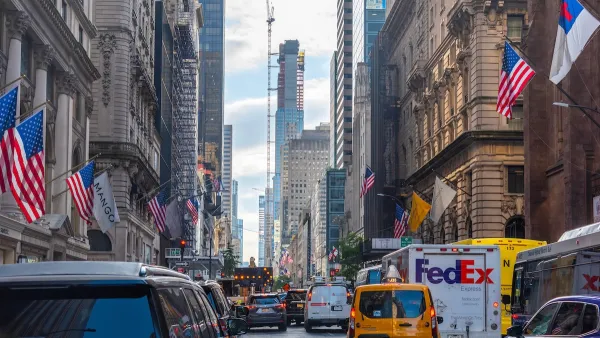
NYC Congestion Pricing: Still Working
10 million fewer vehicles entered the congestion pricing zone in the first six months of the program than last year, while pedestrian fatalities are at ‘historic lows.’
Compromise Struck: Virginia Will Widen I-66 Inside the Beltway
Some local advocates and officials had hoped that tolls and transit could salve the congestion on I-66. Now it will be tolls, transit, and an extra lane.
Wisconsin Struggles with Interstate Tolling Option
State transportation leaders are scrambling to increase funding as MAP-21 draws to its expiration on Oct. 1. Interstate tolling is being eyed by more than a few. While the Wisconsin Assembly likes the idea, Gov. Scott Walker rejects it.

Planetizen Federal Action Tracker
A weekly monitor of how Trump’s orders and actions are impacting planners and planning in America.

‘Going backwards:’ Baltimore mayor, students rally against state's transit funding plan
Maryland's proposed six-year plan provides no funding for Baltimore’s BMORE bus program and reduces its road maintenance funding.

Record-breaking wildlife overpass in Colorado brings 91% reduction in animal collisions
Prior to the overpass, vehicles were hitting one deer per day on Colorado’s Interstate 25.

Mamdani sent nearly 6,000 pied-à-terre tax warnings to homes that didn’t qualify
A judge has ordered the administration to cancel thousands of pied-à-terre tax notices after it sent 35% of them erroneously.

Detroit to transform waterfront with $2.2 billion investment
Developers will convert about 18 acres of unused parking lot space into civic spaces.

‘Going backwards:’ Baltimore mayor, students rally against state's transit funding plan
Maryland's proposed six-year plan provides no funding for Baltimore’s BMORE bus program and reduces its road maintenance funding.

FREE Course: Walkable City 1: Why Walkability?
After describing his path towards focusing on walkability as the essence of good planning, Jeff Speck marches through his five principal reasons for making more walkable places.
Reinventing Malls: Planning Alchemy—Turning Gray Fields Into Gold
The course focuses on the opportunities and imperatives that shape reinvention of mall sites.

City of Thousand Oaks
City of Wisconsin Rapids
Harvard University Graduate School of Design
The Architects Foundation
University of Cincinnati Online
Northern Illinois Transit Authority (NITA)
The Pocatello Development Authority
The Urban Renewal Agency of the City of Pocatello