With fantasies of a Hyperloop suddenly offering a tantalizing, albeit far-fetched, alternative to the $68-billion project, CA's high-speed rail has apparently encountered more schedule slippage. The delay could cause more obstacles for the project.


"The start of construction on California's bullet train, one of the nation's largest 'shovel ready' public work projects that was awarded stimulus funding three years ago by the Obama administration, is slipping past already-delayed target dates," reports project skeptic Ralph Vartabedian. "Now, it appears that serious construction may not begin this year, and could be delayed into 2014."
"Factors contributing to the sluggish start include delays in getting a construction company under contract and lack of key federal permits," he adds. "Under federal agreements, the state must spend all of the Obama administration stimulus funding and a matching amount of state funds by October 2017— about $5 billion of the $6 billion total for the first phase through the Central Valley."
Read the full story: 'Shovel-ready' bullet train construction delayed again
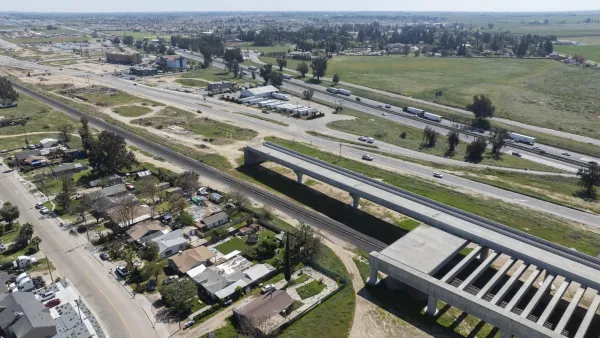
California rail builders sign MOU advancing statewide high-speed network
The agreement aims to create an interconnected high-speed rail network and bring down the cost of construction.

California High-Speed Rail wants to leverage data center revenue to fund trains
By positioning the rail line as a tech and renewable energy corridor, the agency hopes to increase revenue opportunities.
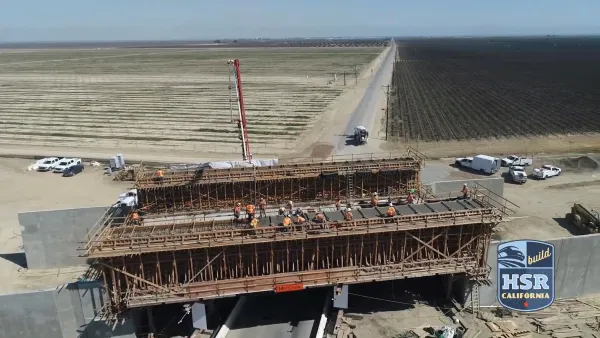
California High-Speed Rail Slashes $1.7B From 2026 Budget
The CHSRA plans to complete the Central Valley segment of the line and begin revenue service as soon as possible.

Planetizen Federal Action Tracker
A weekly monitor of how Trump’s orders and actions are impacting planners and planning in America.

California plans to bury El Niño’s downpour
If the state plays its cards right, it may be able to store a billion acre-feet of El Niño’s water in aquifers.

Desperate measures: Advocates weigh draining Lake Powell to fill Colorado River
Draining the reservoir could reduce evaporation losses by a couple hundred thousand acre-feet.

Chicago voters approve permanent festival grounds, penalty for vacant property owners
Currently, major summer and fall festivals take over public parks for weeks at a time, drawing criticism from nearby residents

NYC votes to cut outdoor dining red tape, speed up permitting
New York City also voted to allow the Department of Transportation to begin work on urgent projects before notifying elected officials.

California appears to reject Prop. 45
The proposition would have expanded the projects that qualify for a streamlined environmental review, effectively paring down the California Environmental Quality Act.

FREE Course: Walkable City 1: Why Walkability?
After describing his path towards focusing on walkability as the essence of good planning, Jeff Speck marches through his five principal reasons for making more walkable places.
Reinventing Malls: Planning Alchemy—Turning Gray Fields Into Gold
The course focuses on the opportunities and imperatives that shape reinvention of mall sites.

City of Rosemead
Rutgers University, Edward J. Bloustein School of Planning and Public Policy
One Hundred Miles
Hunter College, City University of New York (CUNY)
The Architects Foundation
University of Cincinnati Online
City of Cambridge
Montrose County
The Pocatello Development Authority