The CIA, in partnership with other U.S. government agencies, is funding a $630,000 scientific study into the plausibility and potential effects of climate engineering to reduce global warming. Let the conspiracy theories begin.


"The Central Intelligence Agency is funding a scientific study that will investigate whether humans could use geoengineering to alter Earth’s environment and stop climate change," report Chris Mooney and Dana Liebelson. "The National Academy of Sciences will run the 21-month project, which is the first NAS geoengineering study financially supported by an intelligence agency. With the spooks’ money, scientists will study how humans might influence weather patterns, assess the potential dangers of messing with the climate, and investigate possible national security implications of geoengineering attempts."
"Although previous efforts to manipulate weather and climate have often been met with mockery, many geoengineering proposals 'are fundamentally doable, relatively cheap, and do appear to be able to reduce climate risk significantly, but with risks,' explains David Keith, a Harvard researcher and top geoengineering proponent."
Read the full story: CIA backs $630,000 scientific study on controlling global climate
Geoengineering Studies—Plans B and C for Climate Change—Endorsed
The New York Times science writer examines the findings of the National Academy of Sciences panel released Feb. 10 that support further research on the two geoengineering strategies of carbon dioxide removal and solar radiation management.
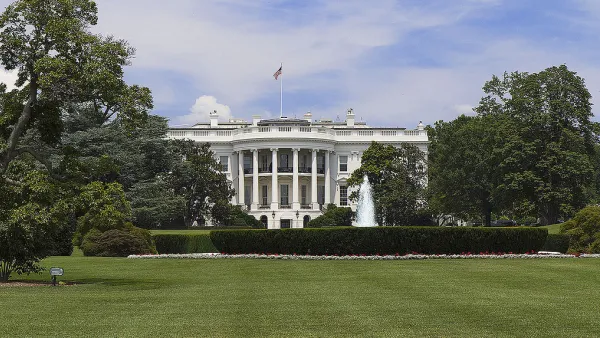
Trump Administration Releases Climate Report that Contradicts EPA Chief
In a move that surprised some, the Fourth National Climate Assessment found that climate change is "unambiguous" as opposed to a "hoax," as President Trump has stated, and that it is man-made, largely caused by the burning of fossil fuels.

Pressure on Trump Administration to Release Climate Report
Scientist are concerned that a congressionally mandated climate assessment, originally authorized under President George H.W. Bush, may not be released by the Trump Administration because it contradicts their rejection of climate science.

Planetizen Federal Action Tracker
A weekly monitor of how Trump’s orders and actions are impacting planners and planning in America.

California plans to bury El Niño’s downpour
If the state plays its cards right, it may be able to store a billion acre-feet of El Niño’s water in aquifers.

Desperate measures: Advocates weigh draining Lake Powell to fill Colorado River
Draining the reservoir could reduce evaporation losses by a couple hundred thousand acre-feet.

Chicago voters approve permanent festival grounds, penalty for vacant property owners
Currently, major summer and fall festivals take over public parks for weeks at a time, drawing criticism from nearby residents

NYC votes to cut outdoor dining red tape, speed up permitting
New York City also voted to allow the Department of Transportation to begin work on urgent projects before notifying elected officials.

California appears to reject Prop. 45
The proposition would have expanded the projects that qualify for a streamlined environmental review, effectively paring down the California Environmental Quality Act.

FREE Course: Walkable City 1: Why Walkability?
After describing his path towards focusing on walkability as the essence of good planning, Jeff Speck marches through his five principal reasons for making more walkable places.
Reinventing Malls: Planning Alchemy—Turning Gray Fields Into Gold
The course focuses on the opportunities and imperatives that shape reinvention of mall sites.

City of Rosemead
Rutgers University, Edward J. Bloustein School of Planning and Public Policy
One Hundred Miles
Hunter College, City University of New York (CUNY)
The Architects Foundation
University of Cincinnati Online
City of Cambridge
Montrose County
The Pocatello Development Authority