The United States' municipal recycling programs rely on China's voracious appetite for plastic trash. But the country's new ban on the import of certain types of solid waste may cause your city a giant, stinky headache.


"As Americans carefully separate the paper and plastics from their trash, most probably don’t realize that their country doesn’t recycle stuff so much as export it to be recycled elsewhere. Specifically, to China. For more than five years, scrap and trash has consistently been the US’s biggest export (paywall), for which China is the number one customer, and the market has doubled in size since 2006," explains Gwynn Guilford.
"But hints are emerging that American cities and the companies that sell trash are in for a rude awakening. A recent sign of this comes from Oregon, where truckloads of plastic are piling up at recycling depots because Chinese buyers cancelled their orders, as Oregon Public Broadcasting reports."
"And it’s not just plastic from Oregon. American waste recycling companies are starting to panic. 'What I’m hearing from folks in the industry, it’s that just that nothing is going,' the industry insider says. '[China's] not taking anything anymore. It’s a greenwall.'”
Read the full story: China doesn’t want your trash anymore—and that could spell big trouble for American cities
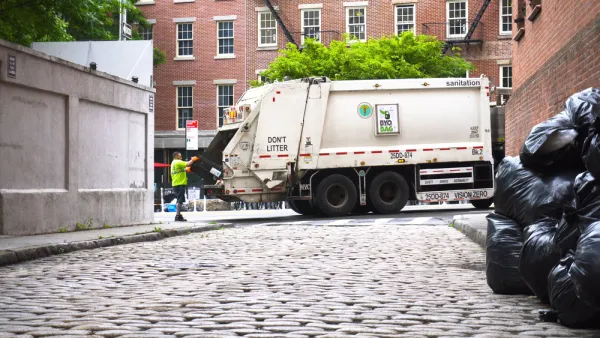
Waste Management Best Practices (And Their Impact on Urban Planning)
Urban planners can play a role in ensuring the best possible waste management practices are implemented whenever possible.
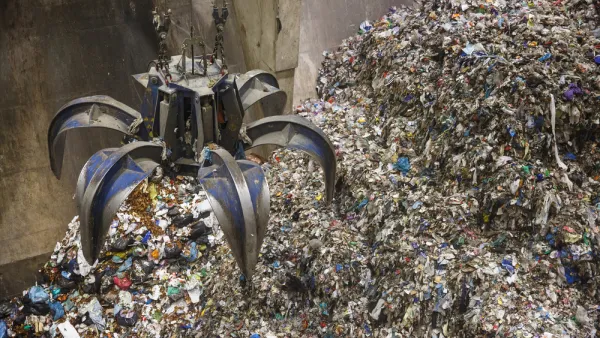
Recyclables Headed to Incinerators or Landfills
China's decision to halt imports of most recyclables from the United States has caused turmoil. With few markets for their recyclables, Philadelphia is sending half of them to a waste-to-energy incinerator in Chester not designed to burn them.

Unique Garbage Challenges in Juneau
Juneau, Alaska's tiny capital city, is not accessible from elsewhere by road. Its isolation makes waste disposal problematic and expensive, spurring an aggressive recycling effort.

Planetizen Federal Action Tracker
A weekly monitor of how Trump’s orders and actions are impacting planners and planning in America.

Washington state to charge fee to drivers with fuel-efficient cars
Revenue from the fee will go towards supporting the state’s highways.

Illinois considers spending $1 billion in taxpayer money on data center
A quantum computing campus and data center are currently under construction in Chicago.

Mamdani to replace Rikers Island with four borough-based jails
The four new jails are set to open between 2029 and 2032.

NYC may allow residents to ‘adopt’ storm drains
A new proposal would establish a volunteer program where residents could help clean debris from storm drains.

‘A price cannot be put on democracy:’ Local leaders protest UMich data center
The 1.25 billion-dollar project would take up 144 acres of land in Ypsilanti Township.

FREE Course: Walkable City 1: Why Walkability?
After describing his path towards focusing on walkability as the essence of good planning, Jeff Speck marches through his five principal reasons for making more walkable places.
Reinventing Malls: Planning Alchemy—Turning Gray Fields Into Gold
The course focuses on the opportunities and imperatives that shape reinvention of mall sites.

City of Charlotte
City of Rosemead
Rutgers University, Edward J. Bloustein School of Planning and Public Policy
University of Michigan School for Environment and Sustainability (SEAS)
Hunter College, City University of New York (CUNY)
The Architects Foundation
University District Partnership