In a scathing op-ed for The New York Times, architect Robert Stern challenges the city's drive to densify East Midtown without paying the requisite attention to preservation, infrastructure, and the elements that give vitality to great cities.


"Last summer the Department of City Planning released its East Midtown study, envisioning a taller, denser, shinier future for the neighborhood around Grand Central. New and more liberal regulations that will allow bigger office towers are on their way to the City Council for approval before the end of Mayor Michael R. Bloomberg’s current term."
"But what is a modern city, exactly?" asks Stern. "And is New York really in danger of falling behind new global cities like Shanghai?"
"I’m nearly always an advocate of density: it’s socially beneficial and environmentally responsible. And I like tall buildings as much as the next architect, especially if I’m asked to design them," he adds. "But the advantages of density can go only so far without the infrastructure to support it. And the appropriateness of tall buildings is a question of where and when, and what they contribute to the public realm."
"The proposed East Midtown up-zoning doesn’t give anything back to New York," Stern concludes. "It’s all about real estate and not about place-making, or should I say, place-saving."
Read the full story: A Modern City in East Midtown?

To Remain Competitive, NYC Should Bolster Placemaking, Not Its Skyline
Michael Kimmelman comes out against the plan to rezone a 73-block area around Grand Central Terminal to allow the replacement of "aging commercial buildings with giant new office towers". The city should focus on planning, not zoning, he argues.
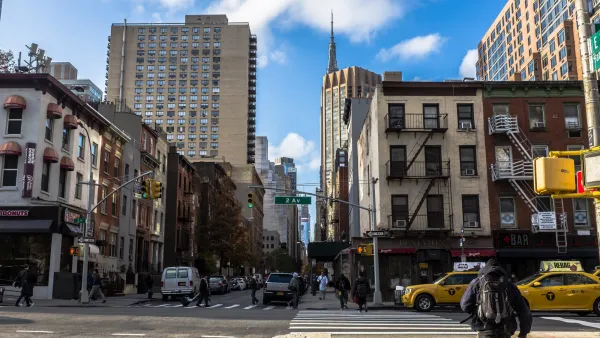
Property Owners Jostle for Deals After Midtown East Rezoning
A flurry of air rights purchases have already begun as large property owners take advantage of Midtown East's upzoning. Some big names include JPMorgan Chase and the Archdiocese of New York.
High-Rise Approval Secures $220 Million for Grand Central Terminal Improvements
In exchange for the approval to build One Vanderbilt, a 63-story office tower adjacent to Grand Central Terminal, the developer will give the MTA $220 million for upgrades to entrances of the Metro-North Railroad and the terminal's subway entrances.

Planetizen Federal Action Tracker
A weekly monitor of how Trump’s orders and actions are impacting planners and planning in America.

Amtrak, CN end decades-long dispute with eight-year agreement
The new operating agreement establishes an updated framework for the companies to work together, including processes to resolve disputes.

Judges permit Denver to divert 77,000 acre feet from the Colorado River for reservoir expansion
Overuse and climate change have caused the Colorado River’s water levels to plummet.

NYC DOT wants faster, more permanent street upgrades
The city is examining ways to build more concrete infrastructure without getting entangled in 'decades-long' projects.

'Something we’ve never seen before:' rising utility rates could strain city finances nationwide
Data centers, climate change and other factors have caused utility rates in the United States to increase by 38% since 2020.

Trump to overrule local leaders, lease millions of acres of America’s Pacific Island territories’ seafloors to mining companies
International law says that the Indigenous people of America’s territories have a right to prior and informed consent regarding projects that impact their countries.

FREE Course: Walkable City 1: Why Walkability?
After describing his path towards focusing on walkability as the essence of good planning, Jeff Speck marches through his five principal reasons for making more walkable places.
Reinventing Malls: Planning Alchemy—Turning Gray Fields Into Gold
The course focuses on the opportunities and imperatives that shape reinvention of mall sites.

Harvard University Graduate School of Design
KFH Group Inc.
Greater Baltimore Committee
The Architects Foundation
University of Cincinnati Online
The Pocatello Development Authority
The Urban Renewal Agency of the City of Pocatello