With more than 10,000 downloads in the U.S., i-Tree calculates the environmental and economic benefits of planting trees.


Based on an analysis by i-Tree, a software program developed by the U.S. Forest Service in partnership with Davey Tree company, street tree coverage in Pittsburgh, Pa. confers $2.4 million in environmental and aesthetic value per year to the city.
I-Tree calculates the carbon sequestration potential of each tree planted and the economic benefits of air pollution reduction. Its next version will also be able to analyze how urban forests affect air temperature, ultraviolet ray penetration and bird habitat.
Using i-Tree, the environmental nonprofit Tree Pittsburgh figured out that the city received $3 in benefits for every dollar it invested in urban forestation. In response, the city developed a new master plan to replenish its canopy, which is at half the recommended coverage now.
I-Tree is designed to be usable by anyone and exists in mobile as well as desktop version.
Read the full story: That tree in the corner may be worth more than your house


What's a Tree Worth?
The U.S. Forest Service has continued to refine the valuable i-Tree software program, which allows cities to calculate the benefits, in dollar figures, of the urban forest.
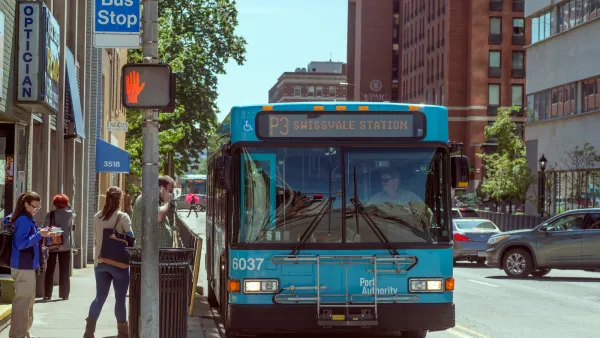
750 Pittsburgh city workers to get free transit passes
City employees working downtown will have access to free transit from Pittsburgh Regional Transit.
Pittsburgh downtown tax diversion plan draws criticism for lack of transparency
A proposed new development tax faces opposition from transit advocates.

Planetizen Federal Action Tracker
A weekly monitor of how Trump’s orders and actions are impacting planners and planning in America.

California plans to bury El Niño’s downpour
If the state plays its cards right, it may be able to store a billion acre-feet of El Niño’s water in aquifers.

Chicago breaks ground on $3 billion megadevelopment
The new neighborhood, titled Foundry Park, will one day host 3,700 residences.

California High-Speed Rail Authority CEO resigns after $600,000 scandal
Under Ian Choudri, the authority used taxpayer dollars to fund first class flights and trips to nightclubs.

Want to study the Missouri River? Soon, you may need unanimous approval from 10 states
Legislation would require 10 governors’ permission to study or build projects moving water outside the basin.

Desperate measures: Advocates weigh draining Lake Powell to fill Colorado River
Draining the reservoir could reduce evaporation losses by a couple hundred thousand acre-feet.

FREE Course: Walkable City 1: Why Walkability?
After describing his path towards focusing on walkability as the essence of good planning, Jeff Speck marches through his five principal reasons for making more walkable places.
Reinventing Malls: Planning Alchemy—Turning Gray Fields Into Gold
The course focuses on the opportunities and imperatives that shape reinvention of mall sites.

City of Rosemead
Rutgers University, Edward J. Bloustein School of Planning and Public Policy
One Hundred Miles
Hunter College, City University of New York (CUNY)
The Architects Foundation
University of Cincinnati Online
City of Cambridge
Montrose County
The Pocatello Development Authority