The arts district in downtown Los Angeles is transforming its industrial buildings into trendy boutiques, restaurants and hotels. The concern is that gentrification will drive out low-paid artists who can no longer afford to live there.


"It was far more exciting for me to be in a place that wasn't already 'there,' so to speak," said Yassmin Sarmadi, who began building her restaurant Church & State seven years ago. She not only works, but also lives, in the arts district. Of gentrification, she said, "I think it's inevitable. It brings a tear to my eye, but it's also progress." Scott Johnson, an architect who also lives in the art district, appreciates the neighborhood's "roughness most suburbanites would find off-putting" in a time when "we're getting bombarded with fake stuff." Los Angeles's arts district has drawn comparisons to New York's meatpacking district and will likely face the same fate of gentrification from its industrial past, "[b]ut for now, the arts district is in a sweet spot of transition for many," writes Roger Vincent.
"When the arts district loft conversion trend took off in the mid-2000s, landlords realized they could get more rent from tech and design companies than they could from warehouse and manufacturing businesses," says Vincent. He adds, "With so many prosperous newcomers making the neighborhood into an urban frontier with hip amenities, some residents are laboring to keep art in the arts district." Commercial rents in the arts district can top $2 per square foot per month, more than prices paid for nearby high-rises.
"It's already too pricey for the majority of artists," said Daniel Lahoda, owner of Lala Gallery. "We will endure the increases as long as we can because we love the neighborhood so much."
Read the full story: Downtown L.A.'s edgy arts district is neighborhood in transition

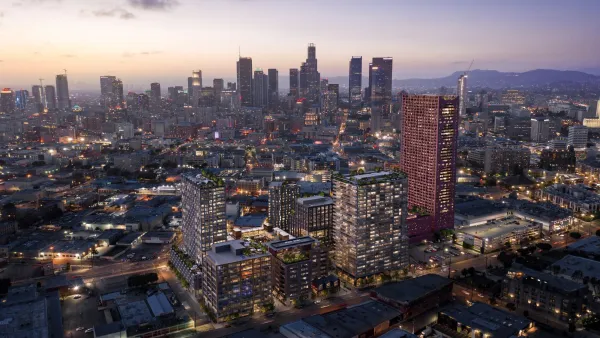
Proposed Megaproject the Latest to Redefine Los Angeles' Core
A proposed $2 billion megaproject would expand the footprint of the ongoing reinvention of Downtown Los Angeles and its surrounding neighborhoods.
Los Angeles Arts District Residents Resisting Plans for More Density
The Arts District in Downtown Los Angeles has seen plenty of chic newcomers in recent years—high-end cafes, restaurants, and expensive lofts. But a recently revealed plan that would allow new, dense construction has sparked controversy.

High Housing Costs Driving Down Transit Ridership in LA
When neighborhoods gentrify and displace lower-income residents, transit ridership suffers, new research shows.

Planetizen Federal Action Tracker
A weekly monitor of how Trump’s orders and actions are impacting planners and planning in America.

Northwest rail fans eager for Sept. 30 debut of Amtrak’s Airo fleet
Get ready for that new train smell and more seats. But they won’t go faster or run more frequently on the Cascades route in Washington and Oregon.

Record-breaking wildlife overpass in Colorado brings 91% reduction in animal collisions
Prior to the overpass, vehicles were hitting one deer per day on Colorado’s Interstate 25.

Detroit to transform waterfront with $2.2 billion investment
Developers will convert about 18 acres of unused parking lot space into civic spaces.

‘Going backwards:’ Baltimore mayor, students rally against state's transit funding plan
Maryland's proposed six-year plan provides no funding for Baltimore’s BMORE bus program and reduces its road maintenance funding.

Trump wants to cancel nearly 98% of funding for HUD housing support program
Multiple housing groups are suing the administration in an effort to preserve the funding.

FREE Course: Walkable City 1: Why Walkability?
After describing his path towards focusing on walkability as the essence of good planning, Jeff Speck marches through his five principal reasons for making more walkable places.
Reinventing Malls: Planning Alchemy—Turning Gray Fields Into Gold
The course focuses on the opportunities and imperatives that shape reinvention of mall sites.

City of Thousand Oaks
City of Wisconsin Rapids
Harvard University Graduate School of Design
The Architects Foundation
University of Cincinnati Online
Northern Illinois Transit Authority (NITA)
The Pocatello Development Authority
The Urban Renewal Agency of the City of Pocatello