The "great global project" of this century, says Patrick Doherty, is how to "accommodate 3 billion additional middle-class aspirants in two short decades." In a bold essay, he outlines how the U.S. must lead the global transition to sustainability.


The United States is in need of a new "grand strategy," says Doherty, director of the Smart Strategy Initiative at the New America Foundation. "The great global project is no longer to stop communism, counter terrorists, or promote a superficial notion of freedom. Rather, the world must accommodate 3 billion additional middle-class aspirants in two short decades -- without provoking resource wars, insurgencies, and the devastation of our planet's ecosystem."
The U.S.'s economic engine, foreign policy, and infrastructure are all out of date, argues Doherty, and to meet the interdependent challenges of the 21st century's strategic landscape - inclusion, depletion, depression, and resilience - the country will need to develop a new strategy: to "lead the global transition to sustainability."
As part of that strategy he envisions a new economic engine for the United States oriented around walkable communities, regenerative agriculture, a revolution in resource productivity, investment in regional growth, and the transition to a reduced carbon emitting energy sector. This strategy will have major implications for the country's foreign policy and governance structures.
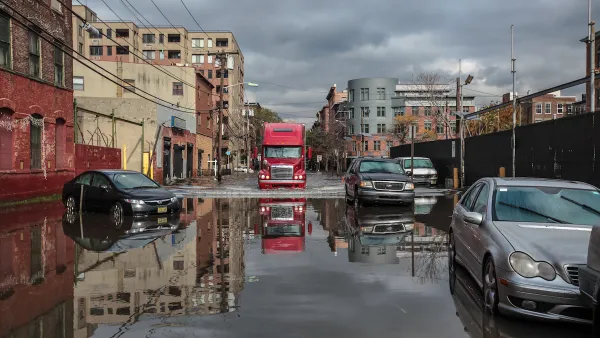
"America has never confronted a global challenge of the type or magnitude it faces today," concludes Doherty. "If it does not change course, the United States will be racked by violent storms -- both figurative and literal -- as the global order breaks down. The country cannot delay. For a few short years, it has a window in which it can choose an incredibly prosperous 21st century, but that window will close. It is time once more to lead the world through difficult change."
Read the full story: A New U.S. Grand Strategy


Seven Brilliant Projects Keeping New Orleans Safe from Stormwater
20 years post Katrina, New Orleans has shored up and reinvented itself to absorb millions upon millions of gallons of stormwater. Their success holds lessons for landscape architects all over the world.

Rebuilding Smarter: How LA County Is Guiding Fire-Ravaged Communities Toward Resilience
Los Angeles County is leading a coordinated effort to help fire-impacted communities rebuild with resilience by providing recovery resources, promoting fire-wise design, and aligning reconstruction with broader sustainability and climate goals.
FEMA Resilience Program Cuts Grant Funding
The Building Resilient Infrastructure and Communities program funded projects from flood prevention to power station upgrades.

Planetizen Federal Action Tracker
A weekly monitor of how Trump’s orders and actions are impacting planners and planning in America.

Amtrak, CN end decades-long dispute with eight-year agreement
The new operating agreement establishes an updated framework for the companies to work together, including processes to resolve disputes.

Judges permit Denver to divert 77,000 acre feet from the Colorado River for reservoir expansion
Overuse and climate change have caused the Colorado River’s water levels to plummet.

NYC DOT wants faster, more permanent street upgrades
The city is examining ways to build more concrete infrastructure without getting entangled in 'decades-long' projects.

'Something we’ve never seen before:' rising utility rates could strain city finances nationwide
Data centers, climate change and other factors have caused utility rates in the United States to increase by 38% since 2020.

Trump to overrule local leaders, lease millions of acres of America’s Pacific Island territories’ seafloors to mining companies
International law says that the Indigenous people of America’s territories have a right to prior and informed consent regarding projects that impact their countries.

FREE Course: Walkable City 1: Why Walkability?
After describing his path towards focusing on walkability as the essence of good planning, Jeff Speck marches through his five principal reasons for making more walkable places.
Reinventing Malls: Planning Alchemy—Turning Gray Fields Into Gold
The course focuses on the opportunities and imperatives that shape reinvention of mall sites.

Harvard University Graduate School of Design
KFH Group Inc.
Greater Baltimore Committee
The Architects Foundation
University of Cincinnati Online
The Pocatello Development Authority
The Urban Renewal Agency of the City of Pocatello