After 25 years, Santa Clara's light rail has failed to live up to its promise, proving to be “among the least successful in the nation” reports Mike Rosenberg, while “serving as a constant reminder that the car is still king in Silicon Valley."


Despite expanding out over a stretch of 42.2 miles, with 62 stations, and serving 32,000 one-way commuters, Silicon Valley's VTA system is still considered to be one of the most costly, slow, inefficient and under-utilized in the nation, writes . It cost $2 billion to build and costs $66 million a year to operate. Each vehicle costs 30 percent more than the national average to operate and carries 30 percent fewer passengers. And the system is heavily subsidized by taxpayers, at the second worst rate in the nation. Critics see it as an innately flawed failure, yet advocates point to decreased freeway traffic while remaining optimistic that usage will increase in years to come.
VTA transportation manager Kevin Connolly contrasts its failures with San Francisco's successes, “[i]n our case we tried to graft a big-city transit type of mode onto a suburban environment, and it's still kind of a work in progress." Routes were planned along onion fields, rather than along existing, dense corridors, and “the density never materialized in Silicon Valley,” notes Rosenberg.
Those who remain optimistic acknowledge there is much improvement to be made. "In general, we can't lose sight of the fact that we have to do the basics better," says Connolly. "We have to be faster, we have to connect with better destinations." Proposals in the pipeline include adding more tracks for express trains, as well as reductions in service costs, which could lead to more funding.
Read the full story: 25 years later, VTA light rail among the nation's worst

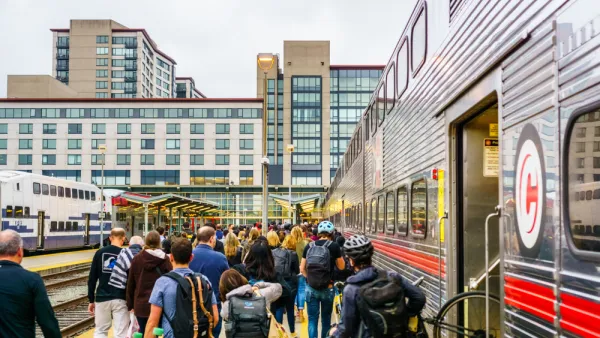
A New Ballot Measure Could Increase Caltrain's Funding by $108 Million Per Year
Santa Clara, San Mateo, and San Francisco county voters could see a ballot measure to fund an ambitious Caltrain plan with a one-eighth cent sales tax, amounting to more than $100 million dollars per year.

San Jose to Vote on $450 Million Affordable Housing Bond
A $450 million bond referendum will come before San Jose voters this November. Mayor Sam Liccardo promises it is "a necessary but not sufficient tool" to provide stable housing at an epicenter of the housing crisis.
Dismal Poll Findings for Bay Area: Half the Respondents Want to Leave
To paraphrase Bill Clinton, it's the housing, stupid! In addition to the troubling findings of the Bay Area Council poll, a California housing report found that Silicon Valley had the highest percentage of residents leaving their counties.

Planetizen Federal Action Tracker
A weekly monitor of how Trump’s orders and actions are impacting planners and planning in America.

Amtrak, CN end decades-long dispute with eight-year agreement
The new operating agreement establishes an updated framework for the companies to work together, including processes to resolve disputes.

Judges permit Denver to divert 77,000 acre feet from the Colorado River for reservoir expansion
Overuse and climate change have caused the Colorado River’s water levels to plummet.

NYC DOT wants faster, more permanent street upgrades
The city is examining ways to build more concrete infrastructure without getting entangled in 'decades-long' projects.

'Something we’ve never seen before:' rising utility rates could strain city finances nationwide
Data centers, climate change and other factors have caused utility rates in the United States to increase by 38% since 2020.

Trump to overrule local leaders, lease millions of acres of America’s Pacific Island territories’ seafloors to mining companies
International law says that the Indigenous people of America’s territories have a right to prior and informed consent regarding projects that impact their countries.

FREE Course: Walkable City 1: Why Walkability?
After describing his path towards focusing on walkability as the essence of good planning, Jeff Speck marches through his five principal reasons for making more walkable places.
Reinventing Malls: Planning Alchemy—Turning Gray Fields Into Gold
The course focuses on the opportunities and imperatives that shape reinvention of mall sites.

Harvard University Graduate School of Design
KFH Group Inc.
Greater Baltimore Committee
The Architects Foundation
University of Cincinnati Online
The Pocatello Development Authority
The Urban Renewal Agency of the City of Pocatello