Paul Goldberger offers a remembrance of the "last lion" of Modernism - Brazilian architect Oscar Niemeyer - who passed away earlier this week at the age of 104.


Niemeyer outlived his peers, worked until the last of his days, and through his 104 years, says Goldberger, "[h]is commitment to the notion that modernism could make life richer, freer, more spirited, and more meaningful also remained fully intact. You could call Niemeyer the last of the true believers, but he was more than that: an extraordinary blend of passion, arrogance, and naivety, seasoned, I suspect, with more than a little craftiness."
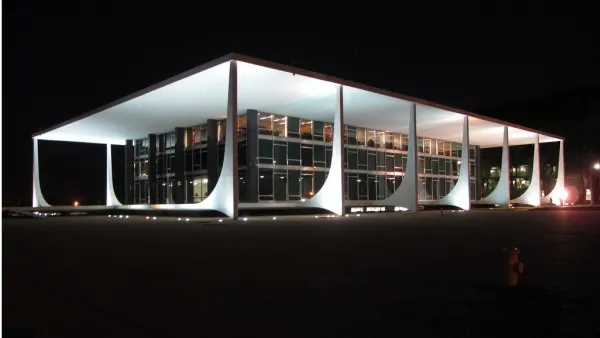
Of course, it's not possible to think of Niemeyer without the ties to his native country - he did after all design much of its futuristic new capital. As Goldberger explains, "Niemeyer was not just an architect who came from Brazil; he was Brazil, as much as Pele or the samba. His swirling forms and his curving lines replaced modernism’s harshness with softness and ease. Niemeyer didn’t compromise modernism’s utopian ideals, but when filtered through his sensibility, the stern, unforgiving rigor of so much European modernism became as smooth as Brazilian jazz. His work is sensuous, almost hedonistic."
And of his most famous creation, the controversial capital, Goldberger adds that, "Niemeyer lived long enough to see Brasilia admired, fall out of favor, and be admired again as a triumph of mid-20th-century design, which is how it ought to be seen—not as a model for how the world should live or how cities should be built, but as a thing unto itself, a fully realized product of a set of deeply held beliefs that, at least for a period, were shared by an entire national government."
Read the full story: Remembering Oscar Niemeyer: The Architect Who Gave Modernism a Little Samba Flair

Master Architect Oscar Niemeyer Dies
Brazil's legendary artist, who spanned the 20th century's major architectural movements with a timeless style that infused the geography and culture of his native country with European modernism died Wednesday at the age of 104.
Niemeyer's Plan to Refresh Brasilia Meets Opposition
Architect Oscar Niemeyer has released plans to build new iconic buildings near the UNESCO-protected cultural and government center he designed in Brasilia 50 years ago. But locals have voiced opposition.
The Legacy of Brasilia
The Atlantic Monthly reviews a new book on architect Oscar Niemeyer and his work that- like the infamous city of Brasilia- "continues to enchant and appall students of architecture and urban planning."

Planetizen Federal Action Tracker
A weekly monitor of how Trump’s orders and actions are impacting planners and planning in America.

‘Going backwards:’ Baltimore mayor, students rally against state's transit funding plan
Maryland's proposed six-year plan provides no funding for Baltimore’s BMORE bus program and reduces its road maintenance funding.

Detroit to transform waterfront with $2.2 billion investment
Developers will convert about 18 acres of unused parking lot space into civic spaces.

HUD, USDA agree on framework to simplify housing environmental review standards
Their agreement is a requirement of the 21st Century ROAD to Housing Act.

Cost of water rising at a faster pace than inflation, median household income
California and Maryland residents have seen their water bills grow especially high.

NYC building owners overwhelmingly comply with new emissions limits
The New York City Department of Buildings is fining owners who did not file emissions reports.

FREE Course: Walkable City 1: Why Walkability?
After describing his path towards focusing on walkability as the essence of good planning, Jeff Speck marches through his five principal reasons for making more walkable places.
Reinventing Malls: Planning Alchemy—Turning Gray Fields Into Gold
The course focuses on the opportunities and imperatives that shape reinvention of mall sites.

planning NEXT
City of Thousand Oaks
City of Wisconsin Rapids
The Architects Foundation
University of Cincinnati Online
Northern Illinois Transit Authority (NITA)
The Pocatello Development Authority
The Urban Renewal Agency of the City of Pocatello