Undaunted by Republican opposition, public setbacks, and budgetary constraints, President Obama plans to forge ahead with his ambitious plan to develop high-speed rail systems across the U.S.


Speaking before a congressional committee this week, Transportation Secretary Ray LaHood reiterated the administration's intention to continue to invest in "its signature transportation project," reports Ashley Halsey III. “We’re not giving up on high-speed rail,” testified LaHood. “The president will include funding in his budget. I think we’ll get there with public money, but in the absence of that we’ll get there with private money.”
Surprisingly, says Halsey, "LaHood’s testimony was welcomed by a majority of members who attended the House Transportation Committee hearing, including a number of Republicans who have expressed varying degrees of skepticism about high-speed rail in the past."
Thus far, "[m]ore than 150 proposals related to the creation of a high-speed rail system have been funded," notes Halsey, "most of them to link major population areas on the two coasts and in the Midwest." However, some in congress believe the administration needs to speed up the pace of work. Del. Eleanor Holmes Norton (D.C.) "suggested launching a pilot program to garner public support."
“I’m not convinced that we know how to do it because we haven’t done it,” Norton said. “There will be huge criticism of the administration for having nothing to show for its efforts in five years.”
Read the full story: Obama pushes ahead with high-speed rail plan
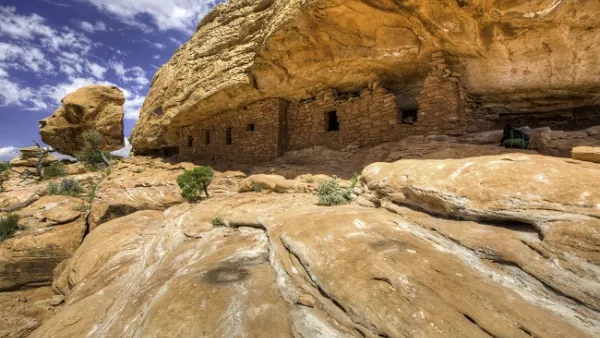
Revoking a National Monument Not Easy, Even with Republican Congress
But that's no reason not to try, figures Republican Rep. Rob Bishop of Utah, chair of the powerful House Natural Resources Committee, who has his sights on the Bears Ears National Monument, barely a month old.
When Regressive is Progressive
With the two Democrat candidates debating who is the real progressive, it would be interesting to see how they would respond, if asked, about President Obama's proposed $10-per-barrel fee to fund a 21st Century Clean Transportation System.
Did Republicans Orchestrate a National High-Speed Derailment?
Was the demise of plans for high-speed rail in several states run by Republican governors the result of fiscal prudence or a case of political collusion? A new report in the Tampa Tribune suggests the latter.

Desperate measures: Advocates weigh draining Lake Powell to fill Colorado River
Draining the reservoir could reduce evaporation losses by a couple hundred thousand acre-feet.

Eastern Nebraska is running out of electricity
Data centers and electrification are straining eastern Nebraska’s grid, throttling economic development.

Malls are becoming the midtowns of the future
Mall and office park redevelopments are a generational opportunity to create new nodes of urbanity.

NYC breaks ground on anti-flooding infrastructure project
New York City's new system will reduce stormwater flows to local sewers by 90%.

One Kentucky town’s secret to affordable housing
The Smoketown Community Land Trust has already built seven affordable homes for community members.

Houston gains petal-shaped cooling infrastructure to make streets more ‘delightful’
The city has installed the pavilions along 15 blocks in Houston.

FREE Course: Walkable City 1: Why Walkability?
After describing his path towards focusing on walkability as the essence of good planning, Jeff Speck marches through his five principal reasons for making more walkable places.
Reinventing Malls: Planning Alchemy—Turning Gray Fields Into Gold
The course focuses on the opportunities and imperatives that shape reinvention of mall sites.

City of Rosemead
Rutgers University, Edward J. Bloustein School of Planning and Public Policy
One Hundred Miles
University of Michigan School for Environment and Sustainability (SEAS)
Hunter College, City University of New York (CUNY)
The Architects Foundation
City of Cambridge
Montrose County
The Pocatello Development Authority