Don't call these modern apartments SROs - they go by 'micro-apartments', and they just received a significant approval, 375 of them, that is. One more step awaits: Mayor Ed Lee must give his blessing, and he appears rather non-committal.


You would think that with San Francisco's apartment shortage, housing advocates would jump on the possibility of building modern, if very small apartments that rent for $1,300 to $1,500 when the average studio goes for $2,075. Not so - lots of concerns have been aired in a city where all want more affordable housing. These include fears of gentrification, making larger apartments more expensive, giving "gifts to developers" and preferring "family-size housing". Key to the approval was placing a cap on the number of 220-square ft. units that can be built.
"Under the legislation, the City Planning Department will analyze the effects of the new units once 325 of them are built", writes Neal J. Riley.
The measure authorizing the units passed Nov. 20 on a 6-1 vote. "Supervisor John Avalos was the lone vote against the proposal, arguing that the city should be more focused on keeping families from moving."
"The cap seemed to satisfy skeptics who say that micro-units are not the solution to the city's housing problem. Supervisor David Campos, who supported the measure, said he visited one of the proposed units and was struck by how expensive rent would be for such a small space."
"Allowing the construction of these units is one tool to alleviate the pressure that is making vacancies scarce and driving rental prices out of the reach of many who wish to live here", claimed the measure's author, Supervisor Scott Weiner.
As for the SRO (single-room-occupancy) moniker (note that two tenants are permitted), it hasn't been lost on this housing advocate - it just went upscale.
"If they become urban crash pads for high-tech employees, then we fear they could have a gentrifying effect on the neighborhoods as they get built," said Ted Gullickson, director of the San Francisco Tenants Union.
Another housing advocate was more direct in the City Insider blog.
“This is not the answer San Francisco needs to solve its housing program,” said Andrew Mendez of the Coalition on Homelessness (that claims to support "Affordable Housing For All"). “This type of housing is just a gift to developers," he charged.
Not so, state the editors of the San Francisco Chronicle, who opined, "We applaud Wiener for figuring out a compromise that will still allow these 375 units to be built, and we urge Mayor Ed Lee to sign this legislation. But we can't go through this as a city each time the affordable-housing faction starts whining about a promising new policy." And for those pushing for 'family-sized housing', the paper points to census data. "Forty percent-plus of San Franciscans live alone, and demographic trends suggest that the number of one-person households is only going to grow."
As for the need for lower-priced studios, Design&Trend made that clear. "San Francisco has overcome New York (to) become the city with the most expensive apartment rents. Though there are increasing criticisms concerning the pint-sized apartments, the demand for affordable living in a growing city is apparently inevitable."
As Planetizen readers know, New York is also experimenting with micro-apartments.
Read the full story: S.F. supervisors back micro-apartments
Urban Congestion Pricing Might Finally Come to California
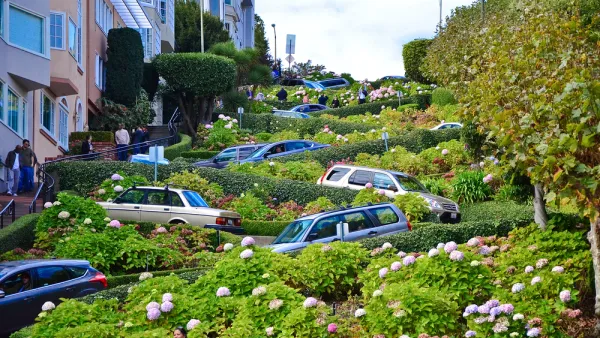
If Gov. Gavin Newsom signs legislation by San Francisco Assemblyman Phil Ting, motorists who want to drive the 'world's most crooked street,' a huge tourist draw, will be forced to participate in a pilot 'reservation and pricing program.'

More EV Charging Coming to San Francisco Private and Public Parking Facilities
To reach an ambitious net-zero target for transportation emissions in San Francisco, Mayor Breed and two supervisors introduced legislation to require large parking facilities provide electric vehicle charging for 10% of spaces.
San Francisco to Use Conservatorship for Some Mentally Ill Homeless People
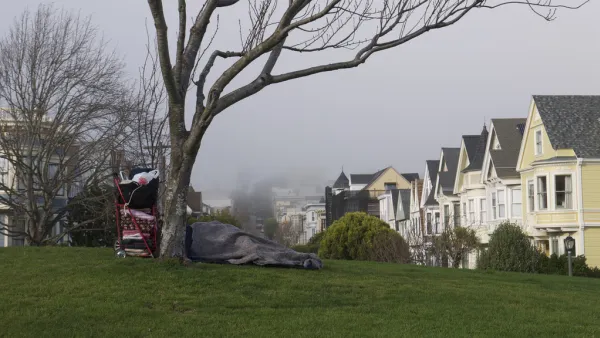
Thanks to legislation by Sen. Scott Wiener passed last year, San Francisco will apply a new tool to force treatment on some homeless, mentally ill people who refuse it, but it's limited to five people annually. A new Wiener bill would expand it.

Planetizen Federal Action Tracker
A weekly monitor of how Trump’s orders and actions are impacting planners and planning in America.

Eastern Nebraska is running out of electricity
Data centers and electrification are straining eastern Nebraska’s grid, throttling economic development.

Move over, LA: St. Louis gears up for Olympics, invests millions in downtown redevelopment
The Missouri city will host the 2028 Olympic soccer group stage and knockout matches.

Dallas releases zoning code overhaul to officials
The drafted overhaul is over 400 pages long.

NYC renovations for dangerous, ‘mercilessly crammed’ street delayed until 2027
Construction was supposed to begin this fall.

San Diego’s Midway Rising project gets greenlight from city council
The project looks to become the largest affordable housing development in California's history.

FREE Course: Walkable City 1: Why Walkability?
After describing his path towards focusing on walkability as the essence of good planning, Jeff Speck marches through his five principal reasons for making more walkable places.
Reinventing Malls: Planning Alchemy—Turning Gray Fields Into Gold
The course focuses on the opportunities and imperatives that shape reinvention of mall sites.

City of Rosemead
Rutgers University, Edward J. Bloustein School of Planning and Public Policy
One Hundred Miles
University of Michigan School for Environment and Sustainability (SEAS)
Hunter College, City University of New York (CUNY)
The Architects Foundation
City of Cambridge
The Pocatello Development Authority
The Urban Renewal Agency of the City of Pocatello