A pilot project spearheaded by the Bloomberg administration to develop a new housing model for the City’s "growing small-household population," has attracted a big response from interested housing developers.


Dubbed adAPT NYC, a call for proposals to develop a "micro-apartment" test project on a city-owned site in Manhattan attracted applications from 33 interested developers, "from major luxury housing builders to those known for creating smaller, innovative projects," reports Laura Kusisto. She noted that, "city officials said they received roughly three times as many
applications as they usually do for a project of this size."
"The City's adAPT NYC competition has ignited a global interest and
conversation about how high-density urban centers can right-size their
housing stock to fit changing demographics," said Mathew Wambua,
commissioner of the housing preservation department.
According to Kusisto, "[s]ome developers said even if they don't win, they can apply some of
the ideas they formulated during the application process to other
projects. 'It's not just about this project....Irrespective of what
happens with this site, we can utilize it in other places,' [Matthew] Blesso
[of developer Blesso Propoerties] said."
Read the full story: Big Run at Micro Concept
Are Small Apartments Hazardous to Your Health?
The growing trend in "micro" living seeks to fill a need for affordable housing in dense and desirable urban environments. But what are the downsides to living in such small spaces? Health experts are raising red flags.
Big Winner of Tiny Apartment Competition Unveiled
Today, Mayor Michael Bloomberg announced the winner of a competition to build a micro-apartment pilot project in Manhattan. Consisting of 55 micro-units measuring between 250 and 375 square feet, the project will utilize modular construction.
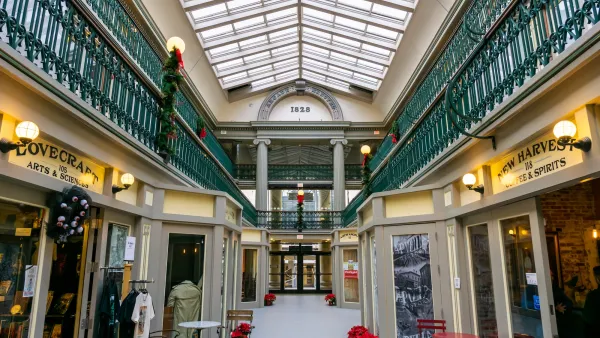
You Can Live Inside America’s Oldest Indoor Shopping Mall
The Arcade in Providence, Rhode Island, first built in 1828, was redeveloped into 48 micro-housing units.

Planetizen Federal Action Tracker
A weekly monitor of how Trump’s orders and actions are impacting planners and planning in America.

Eastern Nebraska is running out of electricity
Data centers and electrification are straining eastern Nebraska’s grid, throttling economic development.

Move over, LA: St. Louis gears up for Olympics, invests millions in downtown redevelopment
The Missouri city will host the 2028 Olympic soccer group stage and knockout matches.

Dallas releases zoning code overhaul to officials
The drafted overhaul is over 400 pages long.

NYC renovations for dangerous, ‘mercilessly crammed’ street delayed until 2027
Construction was supposed to begin this fall.

San Diego’s Midway Rising project gets greenlight from city council
The project looks to become the largest affordable housing development in California's history.

FREE Course: Walkable City 1: Why Walkability?
After describing his path towards focusing on walkability as the essence of good planning, Jeff Speck marches through his five principal reasons for making more walkable places.
Reinventing Malls: Planning Alchemy—Turning Gray Fields Into Gold
The course focuses on the opportunities and imperatives that shape reinvention of mall sites.

City of Rosemead
Rutgers University, Edward J. Bloustein School of Planning and Public Policy
One Hundred Miles
University of Michigan School for Environment and Sustainability (SEAS)
Hunter College, City University of New York (CUNY)
The Architects Foundation
City of Cambridge
The Pocatello Development Authority
The Urban Renewal Agency of the City of Pocatello