Sustainable real estate developer, A-P Hurd asks some fundamental questions about the on-street parking in her Seattle neighborhood and concludes that residents should be able to do more than park cars with the spots in front of their homes.


Hurd writes, "Most of us in single family neighborhoods have a proprietary relationship with the street parking spot in front of their house. We think: "someone is parked in MY spot."
Generally speaking, the street space in front of homes is not owned by the homeowner - but that doesn't deter A-P Hurd, who is also a Runstad Fellow in the College of Built Environments at the University of Washington from exploring possibilities
Living on a narrow street, she asks, "Why is the city in the business of paving and maintaining three lanes of street when only one of them is actually moving cars?" (See her photo of her street in article).
Her next questions stem from the observation that 'curb lanes' are used for nothing but car storage, even when the homes may have driveways and carports or garages.
- "Why should local zoning require on-site parking when hardly any one is using their on-site parking for parking?"
- "The most interesting question: If we think on-site parking has better uses than parking, could we elect to use our street parking for better uses as well?"
- If the resident has "zero, or even one car per household, you're not really allowed to do anything else with that space, so you're losing out relative to your multi-car neighbors." Is that fair?
"Given that people do have this (proprietary) relationship with the parking spot in front of their house, what if we enabled them to do something other than park there? Some compact neighborhoods have taken to putting bike corrals or patios in parking spots..." (photos shown of Mission District parklet, San Francisco and Melrose Market Bike Corral, Seattle).
Hurd doesn't insist on parklets - she suggests 'monetizing' the parking, which is what "The High Price of Free Parking" author, Donald Shoup, defines as a Parking Benefit District. And technology has already jumped on this monetization - there's an 'app' for that.
Bottom line: "There is wasted space in the "parking" lanes of our single family neighborhoods. Let's build some frameworks that open up these spaces to human ingenuity, and see if we can't get more value out of them."
Hurd is also the "author of a recent book of practical strategies to get to better cities and stronger economies using less energy: The Carbon Efficient City."
Thanks to The Atlantic Cities newsletters
Read the full story: That Parking Spot In Front of Your House Doesn't Belong to You

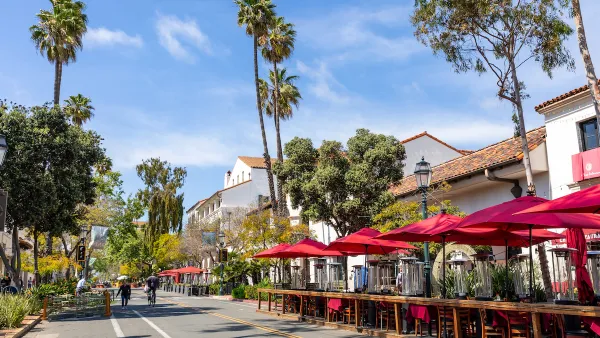
Santa Barbara Renews Parklet Program
The city updated its pandemic-era on-street dining program with new regulations that limit the locations and design of parklets.
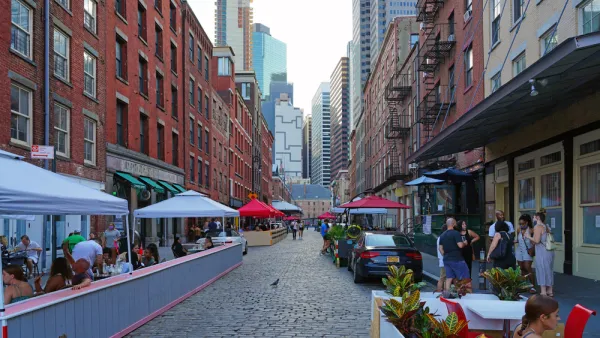
Cities Rethinking the Value of Parking
The effort to reclaim public and private spaces from car storage had some setbacks since the days of al fresco and open streets in the first years of Covid-19. But widespread parking reforms and new evidence shows the public is rethinking parking.
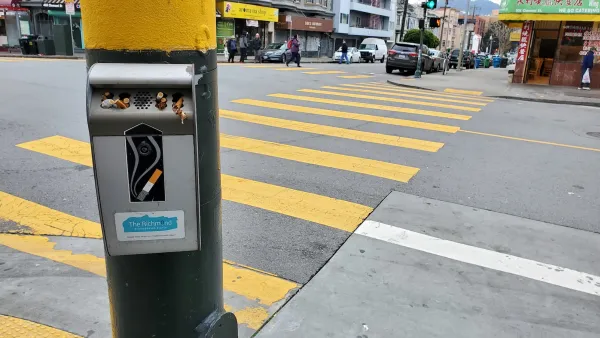
San Francisco weighs patio smoking ban
Business owners say the ban could force patrons onto sidewalks and disrupt long-standing bar culture, while proponents of the ordinance say second-hand smoke is a threat to patrons and workers.

Planetizen Federal Action Tracker
A weekly monitor of how Trump’s orders and actions are impacting planners and planning in America.

Amtrak, CN end decades-long dispute with eight-year agreement
The new operating agreement establishes an updated framework for the companies to work together, including processes to resolve disputes.

Northwest rail fans eager for Sept. 30 debut of Amtrak’s Airo fleet
Get ready for that new train smell and more seats. But they won’t go faster or run more frequently on the Cascades route in Washington and Oregon.

St. Louis Metro to test if single-car trains can reduce operating costs, maintain rider satisfaction
The pilot program will run from October to spring 2027, and begin with one single-car train operating on Metrolink’s Red and Blue lines.

Pennsylvania is building data centers in abandoned mines
Housing data centers in mines provides an alternative to destroying local forests and may spare residents from data centers’ noise and air pollution.

If Corpus Christi can’t revive desalination plant project, it may owe Texas $235 million
Earlier this month, city officials declined to pursue developing the plant for the second time in a year.

FREE Course: Walkable City 1: Why Walkability?
After describing his path towards focusing on walkability as the essence of good planning, Jeff Speck marches through his five principal reasons for making more walkable places.
Reinventing Malls: Planning Alchemy—Turning Gray Fields Into Gold
The course focuses on the opportunities and imperatives that shape reinvention of mall sites.

City of Thousand Oaks
City of Wisconsin Rapids
Harvard University Graduate School of Design
The Architects Foundation
University of Cincinnati Online
The Pocatello Development Authority
The Urban Renewal Agency of the City of Pocatello