Something will be done to help Denver's Elyria and Swansea neighborhoods recover from decades of decline brought by the construction of I-70. Will a plan to bury the interstate be replaced with an ambitious proposal to reroute the road entirely?


Monte Whaley discusses the competing visions for how to "make way for the rebirth of a depressed part of [Denver]" that was severed by the construction of Interstate 70. The Colorado Department of Transportation (CDOT) favors a $1 billion plan to bury the highway and cap it with an 800-foot-long deck that could provide park space.
For some activists though, CDOT's plan "is not bold enough to save the Elyria and Swansea neighborhoods."
"CDOT
is really good at laying concrete," said Thaddeus Tecza, a senior
instructor emeritus of political science at the University of Colorado.
"These guys are engineers, and their answer to everything is to put down
a lane of concrete. What they are not really good at is planning for a
community."
"Tecza and Frank Sullivan - a retired biology
instructor at Front Range Community College - in August presented their
idea for realigning I-70 around Denver using the corridor occupied by
Interstates 270 and 76."
At an estimated cost of $4-$5 billion, CDOT nixed the Tecza and Sullivan plan last week. However, according to Whaley, "Tecza is undeterred, as are others who see the
East I-70 corridor as a unique opportunity to revamp north Denver and
maybe beyond."
Read the full story: Planners suggest rerouting I-70 out of central Denver

Denver to Focus on Reviving Long-Neglected Area of the City
A $1.8 billion proposal to bury I-70 beneath a landscaped lid is just part of an ambitious plan to remake a 23-mile corridor of northeast Denver that includes the Elyria-Swansea and Globeville neighborhoods.
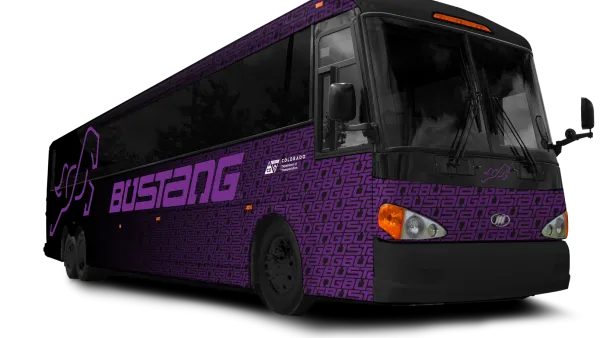
Commuting to Denver from Colorado Springs Gets Easier
Thanks to Bustang, an interregional bus service that began July 13, commuters can relax in reclining, high-back chairs or choose to plug their devices into outlets and utilize wifi for the 69-mile trip between Colorado's two largest cities.
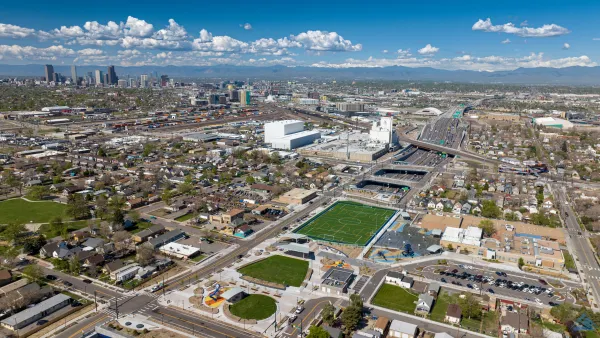
Opening of Denver’s New Freeway Cap Park Triggers Gentrification Fears
Local residents fear rising housing costs and displacement with the opening of a new four-acre park built on a deck bridge over the newly reconstructed and widened I-70 interstate.

Planetizen Federal Action Tracker
A weekly monitor of how Trump’s orders and actions are impacting planners and planning in America.

Amtrak, CN end decades-long dispute with eight-year agreement
The new operating agreement establishes an updated framework for the companies to work together, including processes to resolve disputes.

Judges permit Denver to divert 77,000 acre feet from the Colorado River for reservoir expansion
Overuse and climate change have caused the Colorado River’s water levels to plummet.

NYC DOT wants faster, more permanent street upgrades
The city is examining ways to build more concrete infrastructure without getting entangled in 'decades-long' projects.

'Something we’ve never seen before:' rising utility rates could strain city finances nationwide
Data centers, climate change and other factors have caused utility rates in the United States to increase by 38% since 2020.

Trump to overrule local leaders, lease millions of acres of America’s Pacific Island territories’ seafloors to mining companies
International law says that the Indigenous people of America’s territories have a right to prior and informed consent regarding projects that impact their countries.

FREE Course: Walkable City 1: Why Walkability?
After describing his path towards focusing on walkability as the essence of good planning, Jeff Speck marches through his five principal reasons for making more walkable places.
Reinventing Malls: Planning Alchemy—Turning Gray Fields Into Gold
The course focuses on the opportunities and imperatives that shape reinvention of mall sites.

Harvard University Graduate School of Design
KFH Group Inc.
Greater Baltimore Committee
The Architects Foundation
University of Cincinnati Online
The Pocatello Development Authority
The Urban Renewal Agency of the City of Pocatello