Despite more bicyclists on its streets, Philadelphia has seen a marked reduction in bike crashes and deaths. With double the amount of cyclists on downtown streets since 2002, the decline is being attributed to more visibility to motorists.


Paul Nussbaum reports on Philadelphia's dramatic decline in accidents involving bicycles, from a high of 1,040 in 1998 to 553 in 2010, which officials and advocates attribute to the "safety in numbers" phenomenon.
"'Where cars expect to find bicyclists and pedestrians, drivers are
more cognizant of cyclists and pedestrians,' said Alex Doty, executive
director of the Bicycle Coalition of Greater Philadelphia. He cited a
study in Portland, Ore., that found a doubling of the number of bicycles
reduced the crash risk by one-third."
"I know I get better
treatment now than I did 10 years ago, or even five years ago," Doty
said. "Drivers have a better idea what to do. Though there is still
quite a bit of room for improvement."
"If more biking means safer biking, safer biking is likely to produce more biking," says Nussbaum.
FULL STORY: More bicyclists means fewer accidents, Phila. finds

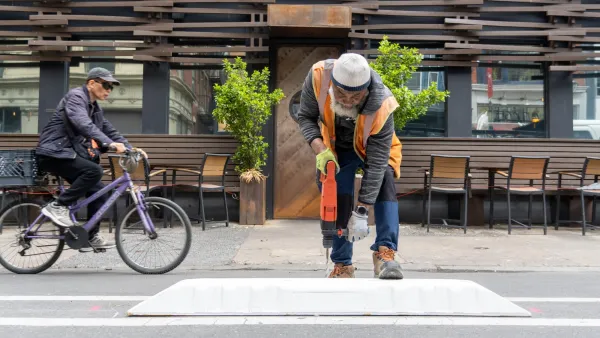
Philadelphia adds new safety measures to 13th Street bike lane
The city is piloting plastic, modular bike lane separators that buffer cyclists from the adjacent vehicle lane.
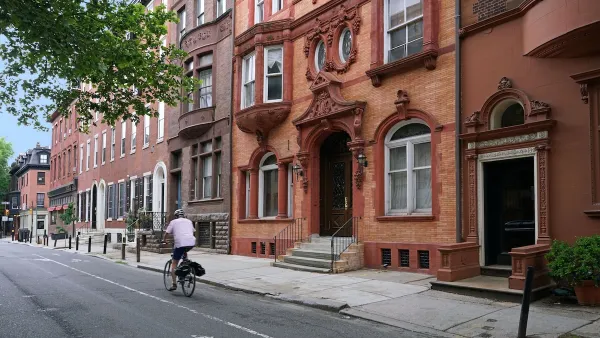
Philly Council Wants to Crack Down on Bike Lane Parking
The city council passed a bill that would raise penalties and eliminate a grace period for drivers who stop in bike lanes.

Philadelphia Could Start Citing Drivers for Blocking Bike Lanes
City officials will consider several road safety bills that include higher penalties for stopping in bike lanes and an assessment of the city’s Vision Zero funding.

Planetizen Federal Action Tracker
A weekly monitor of how Trump’s orders and actions are impacting planners and planning in America.

The state-sanctioned urbicide of Austin
People don’t kill cities. Freeways do.

US to reduce Colorado River water deliveries to Mexico
A new Colorado Treaty amendment reduces Mexico’s Colorado River water allocation by 250,000 acre feet.

Brightline West’s future may rely on $6 billion federal loan
The company has until Nov. 2 to make a $400 million equity investment into its proposed high-speed rail line.

LA Metro’s ultimatum: no extra buses for LA28 if federal funding isn’t imminently secured
If Metro does not provide additional buses, LA28 organizers will have to find a new way to manage Olympic traffic. LA28’s budget does not include a line item for transit.

Colorado’s Largest Data Center Could Rise Next to Homes — Without a Public Hearing
The proposed campus would consume 11 times the power of Denver International Airport; as it has across the country, opposition mounts.

FREE Course: Walkable City 1: Why Walkability?
After describing his path towards focusing on walkability as the essence of good planning, Jeff Speck marches through his five principal reasons for making more walkable places.
Reinventing Malls: Planning Alchemy—Turning Gray Fields Into Gold
The course focuses on the opportunities and imperatives that shape reinvention of mall sites.

Eagle County Government
Harvard University Graduate School of Design
Nashville Planning Department
The Architects Foundation
University of Cincinnati Online
The Pocatello Development Authority
The Urban Renewal Agency of the City of Pocatello
Journal of the American Planning Association