By requiring the U.S. auto fleet to average 54.5 miles per gallon by 2025, the standards announced today by the Obama administration will significantly cut U.S. oil consumption and greenhouse gas emissions, reports Juliet Eilperin.


According to Eilperin, Tuesday's announcement of the "historic" rules by Transportation Secretary Ray LaHood and EPA
Administrator Lisa P. Jackson, "will mark the culmination of a compromise
the White House forged between the auto industry, environmentalists,
labor unions and the state of California."
"Unlike many energy policies enacted under President Obama, the vehicle
standards are a relatively uncontroversial move embraced by industry and
environmentalists alike," notes Eilperin. However not all are supportive of the new rules: "presumptive GOP presidential nominee Mitt Romney has vowed to overturn them if elected."
"Kevin
Kennedy, who directs the U.S. climate initiative at the World Resources
Institute, noted that light-duty vehicle emissions represent
approximately 17 percent of the country's total greenhouse gas emissions."
"These
rules represent one of the best opportunities for the administration to
take a bite out of emissions that are damaging the planet, and in a way
that's good for consumers and the auto industry," Kennedy said.
Read the full story: Autos must average 54.5 mpg by 2025, new EPA standards are expected to say

Momentous Climate Plan Being Development by Obama
An historic plan to limit greenhouse gas emissions is being covertly developed by the Obama administration, reports Neela Banerjee. The plan could for the first time set limits on the country's biggest emitters: power plants.
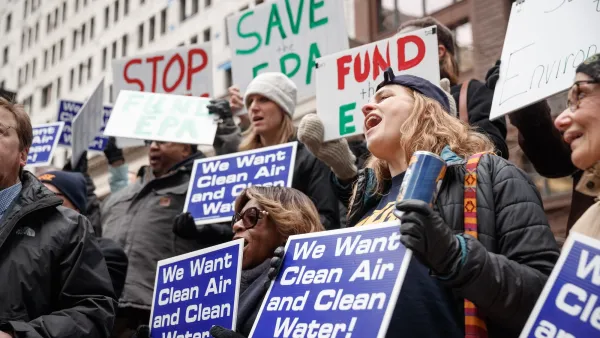
EPA Guts Emissions Regulations
The agency is eliminating the endangerment finding that underpins the agency’s authority to regulate greenhouse gas emissions.
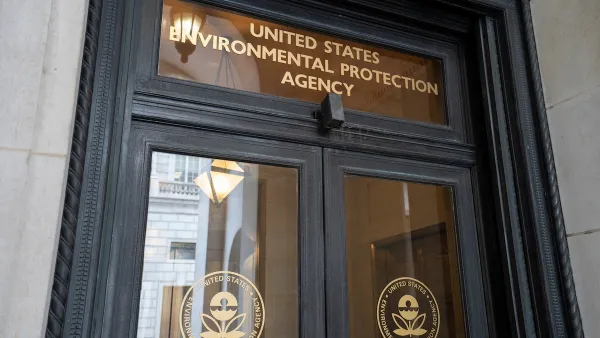
EPA Plans “Largest Deregulatory Action” in History
The agency plans to repeal a key 2009 rule that underpins the government’s authority to regulate greenhouse gas emissions.

Planetizen Federal Action Tracker
A weekly monitor of how Trump’s orders and actions are impacting planners and planning in America.

California plans to bury El Niño’s downpour
If the state plays its cards right, it may be able to store a billion acre-feet of El Niño’s water in aquifers.

Chicago breaks ground on $3 billion megadevelopment
The new neighborhood, titled Foundry Park, will one day host 3,700 residences.

One of Denver’s busiest corridors to gain BRT
The project will span 18 miles and contain 74 bus rapid transit stations.

275,000 bus trips are at stake on Seattle's ballot
If passed, the Seattle Transit Measure would trigger a 0.3% sales tax and raise an average of $138 million per year to maintain and expand Seattle’s bus services.

Texas may pay Israeli company billions to ease water woes
Texas awarded IDE Technologies the contract for its Harbor Island project, which is slated to become the Western Hemisphere's largest desalination plant.

FREE Course: Walkable City 1: Why Walkability?
After describing his path towards focusing on walkability as the essence of good planning, Jeff Speck marches through his five principal reasons for making more walkable places.
Reinventing Malls: Planning Alchemy—Turning Gray Fields Into Gold
The course focuses on the opportunities and imperatives that shape reinvention of mall sites.

City of Rosemead
Rutgers University, Edward J. Bloustein School of Planning and Public Policy
One Hundred Miles
Hunter College, City University of New York (CUNY)
The Architects Foundation
University of Cincinnati Online
City of Cambridge
Montrose County
The Pocatello Development Authority