Melanie Eversley writes on the healing power of urban gardens and farms for refugees new to the U.S. who are looking for a taste of home.


Gardens and farms serve more purposes than just as pretty scenery or means of agricultural production. These green spaces are also serving as places of sanctuary and opportunity for refugees who have just come to the U.S. through the International Rescue Committee (IRC). A 6-year old program called New Roots helps "refugees get used to their new countries by allowing them to do something that is familiar and empowering: growing things."
New Roots already has more than 400 refugees tending their 17 farms in nine cities across the country. The program's benefits are twofold, empowering those recently displaced from their native countries and aiding efforts to supply more fresh food to urban communities.
"Food is one of the most significant, visceral ways we are connected to culture," states New Roots' national coordinator Ellie Igoe. "Refugees have been disconnected from those kinds of rituals. When that happens, we suffer emotionally. And so when we're able to get back to those things, it enlivens us."
Thanks to Daniel Lippman
Read the full story: Urban gardens allow refugees to plant roots
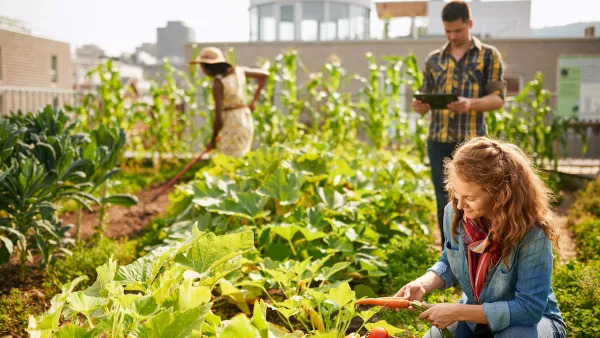
How Cities Can Support Urban Gardeners
Urban agriculture can provide green spaces, fresh food, and healthy activities, but urban gardeners and foragers face many obstacles.
No Connection Between Gardens and Gentrification in Detroit, Study Says
Research from late 2021 documented the footprint of urban gardens in Detroit, finding evidence of inequities but not gentrification.
A Microfarm Grows in an L.A. Front Yard
The founder of Asante Microfarm hopes his farm will serve as a model for bringing fresh produce to underserved communities.

Desperate measures: Advocates weigh draining Lake Powell to fill Colorado River
Draining the reservoir could reduce evaporation losses by a couple hundred thousand acre-feet.

Eastern Nebraska is running out of electricity
Data centers and electrification are straining eastern Nebraska’s grid, throttling economic development.

Malls are becoming the midtowns of the future
Mall and office park redevelopments are a generational opportunity to create new nodes of urbanity.

NYC breaks ground on anti-flooding infrastructure project
New York City's new system will reduce stormwater flows to local sewers by 90%.

One Kentucky town’s secret to affordable housing
The Smoketown Community Land Trust has already built seven affordable homes for community members.

Houston gains petal-shaped cooling infrastructure to make streets more ‘delightful’
The city has installed the pavilions along 15 blocks in Houston.

FREE Course: Walkable City 1: Why Walkability?
After describing his path towards focusing on walkability as the essence of good planning, Jeff Speck marches through his five principal reasons for making more walkable places.
Reinventing Malls: Planning Alchemy—Turning Gray Fields Into Gold
The course focuses on the opportunities and imperatives that shape reinvention of mall sites.

City of Rosemead
Rutgers University, Edward J. Bloustein School of Planning and Public Policy
One Hundred Miles
University of Michigan School for Environment and Sustainability (SEAS)
Hunter College, City University of New York (CUNY)
The Architects Foundation
City of Cambridge
Montrose County
The Pocatello Development Authority