Last week, Los Angeles Mayor Antonio Villaraigosa launched the city's "50 Parks Initiative," a public-private partnership that plans to add over 170 acres of new park space throughout the city's "park-poor population-dense" neighborhoods.


Joe Linton details Mayor Villaraigosa's ambitious initiative to build 50 new parks throughout the city, which was launched last Thursday with the grand opening of two new parks in South Los Angeles built on sites formerly occupied by dilapidated housing.
"Despite city budget shortfalls, the down economy presented an important
window for acquiring land," reports Linton. "Under the city charter, park land acquired
is permanently dedicated to park uses. [Recreation and Parks Commission President] Sanders touted these new
acquisitions as an important opportunity to ending the injustice of
unequal park distribution, with fewer facilities in L.A.'s densest
communities of color."
According to a city press release, "Locations for the 50 Parks Initiative were determined by analyzing key
demographic statistics including population density, median household
income, number and percentage of residents in poverty, and the number of
existing parks in a half-mile radius."
"The city plans to have all fifty new park sites acquired by next summer
when Villagraigosa's completes his term," notes Linton. "The projects are in various
states – a few completed, some acquired, some funded, and some where
funding is anticipated."
Read the full story: Villaraigosa Announces Ambitious Initiative for 50 New Parks
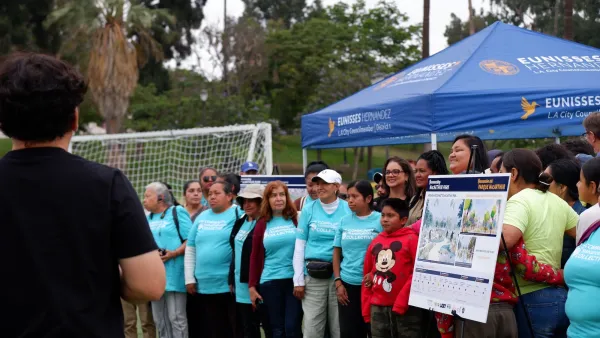
LA unveils plans to reconnect MacArthur Park
The construction of Wilshire Boulevard split the park in two in 1934.
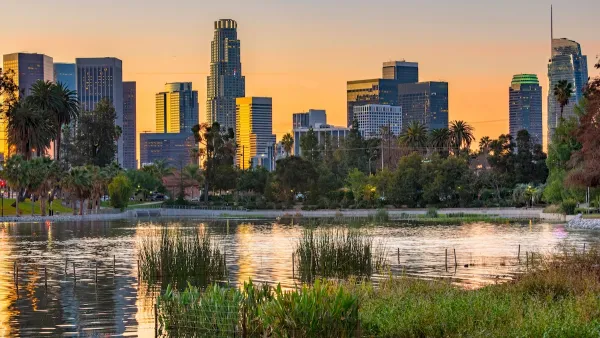
Delivering on the Promise of Parks
In LA County, even amid budget challenges, new parks are opening, targeted investments are being made in underserved communities, and long-term plans are guiding progress — demonstrating a sustained commitment to parks as essential infrastructure.
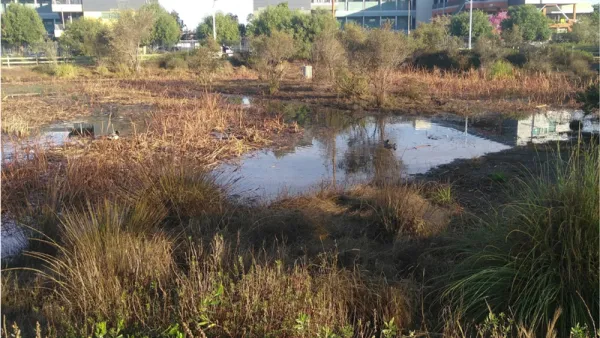
How South LA Green Spaces Power Community Health and Hope
Green spaces like South L.A. Wetlands Park are helping South Los Angeles residents promote healthy lifestyles, build community, and advocate for improvements that reflect local needs in historically underserved neighborhoods.

Planetizen Federal Action Tracker
A weekly monitor of how Trump’s orders and actions are impacting planners and planning in America.

Eastern Nebraska is running out of electricity
Data centers and electrification are straining eastern Nebraska’s grid, throttling economic development.

Study reveals best places in the U.S. for cycling, walking
New research from Streetlight Data examines bicycle and pedestrian miles per capita in the 100 largest U.S. cities by population.

DSA members accuse Mamdani of 'abandoning values' over housing redevelopment
New York City's mayor plans to replace about 2,000 units of public housing with private, mixed-income housing.

All sides of BRT debate unhappy with CDOT’s most recent move
The Colorado Department of Transportation is no longer considering center-running bus lanes for Colorado Boulevard.

Massachusetts bogs generate both power, and cranberries
Putting solar panels above farmland is one way Massachusetts is advancing toward its goal of net-zero carbon emissions by 2050.

FREE Course: Walkable City 1: Why Walkability?
After describing his path towards focusing on walkability as the essence of good planning, Jeff Speck marches through his five principal reasons for making more walkable places.
Reinventing Malls: Planning Alchemy—Turning Gray Fields Into Gold
The course focuses on the opportunities and imperatives that shape reinvention of mall sites.

City of Rosemead
Rutgers University, Edward J. Bloustein School of Planning and Public Policy
One Hundred Miles
University of Michigan School for Environment and Sustainability (SEAS)
Hunter College, City University of New York (CUNY)
The Architects Foundation
City of Cambridge
The Pocatello Development Authority
The Urban Renewal Agency of the City of Pocatello