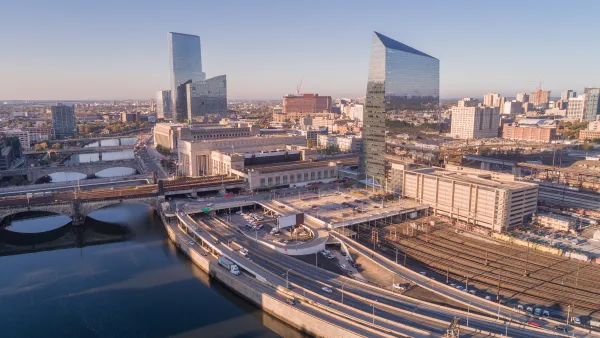
Located adjacent to the nation's 3rd busiest train station, Philly's new multi-use plaza - dubbed The Porch - provides a welcoming entryway to the city and a model for a "lighter, quicker, cheaper" approach to urban improvements.


Switchboard's Kaid Benfield reports on the surprising transformation taking place adjacent to Philadelphia's 30th Street Station. With a limited budget, a space once reserved for parking has been transformed into a new, lively urban plaza. "It is ambitious because, in its statement when The Porch opened," says Benfield, "[University City District (UCD)] said that it 'sees this new space as Philadelphia's front porch, a welcoming entryway to the city, as well as a place to linger and socialize, and to entertain and be entertained. The Porch serves to balance the indoor grandeur of 30th Street Station with the wonder and expanse of Philadelphia.'"
Indeed, the space has been popular, with locals and visitors frequenting the site, sometimes coming back multiple times daily for a round of miniature golf. "The space is adjacent to the country's third busiest train station and within easy walking distance of over 16,000 jobs," notes Benfield. "UCD's executive director, Matt Bergheiser, says that 1,800 pedestrians on average stroll along the sidewalk every hour on weekdays."
According to Benfield, a key to the success of 'The Porch' is it's "lighter, quicker, cheaper" focus. Instead of investing in large capital expenses, cities like Philadelphia are finding they can do just as much, if not more, with less. For example, "the site's planters are recycled and refurbished troughs formerly used to feed livestock," says Benfield.
Read the full story: Philadelphia's lively new park-in-phases creates a "front porch" for residents, commuters, visitors
Master Plan Envisions New Neighborhood Around Philly’s 30th Street Station
A partnership led by Amtrak plans to redevelop the area around a historic train station with mixed-use buildings, cultural amenities, and open space.
Radical University-Led Project Could Transform Philadelphia
Drexel University is proceeding with a study to determine the feasibility of capping and building over the Schuylkill Rail Yards, a transformational project that could unite West Philadelphia with the Center City, reports Susan Snyder.
Collaboration Breeds New Capabilities in Philadelphia
Alex Vuocolo reports on the new model of multi-stakeholder collaboration that is bringing acclaimed public spaces, and economic growth, to the city of Philadelphia.

Planetizen Federal Action Tracker
A weekly monitor of how Trump’s orders and actions are impacting planners and planning in America.

California plans to bury El Niño’s downpour
If the state plays its cards right, it may be able to store a billion acre-feet of El Niño’s water in aquifers.

Desperate measures: Advocates weigh draining Lake Powell to fill Colorado River
Draining the reservoir could reduce evaporation losses by a couple hundred thousand acre-feet.

Housing is the top priority of Seattle’s sole new councilmember
Jenks campaigned on building 1,000 new units of affordable housing.

New tax cuts may slash $1.5 billion in funding for Miami transit, public parks
Amendment 3 will save Miami-Dade homeowners $2,700 in 2028.

Arizona, Wisconsin, Pennsylvania hope to finally advance climate goals post-midterms
The three states have spent years under Republican or divided control.

FREE Course: Walkable City 1: Why Walkability?
After describing his path towards focusing on walkability as the essence of good planning, Jeff Speck marches through his five principal reasons for making more walkable places.
Reinventing Malls: Planning Alchemy—Turning Gray Fields Into Gold
The course focuses on the opportunities and imperatives that shape reinvention of mall sites.

City of Rosemead
Rutgers University, Edward J. Bloustein School of Planning and Public Policy
One Hundred Miles
University of Michigan School for Environment and Sustainability (SEAS)
Hunter College, City University of New York (CUNY)
The Architects Foundation
City of Cambridge
Montrose County
The Pocatello Development Authority