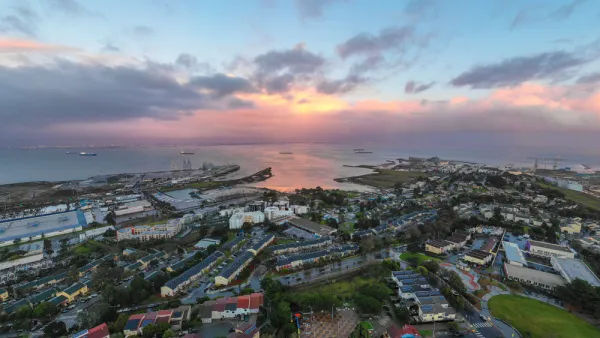
The Bayview Hunters Point/Candlestick Point project in San Francisco looks like it'll be significantly funded by an unlikely source: the China Development Bank. Bruce Katz and Robert Puentes believe that this deal could change U.S.-China relations.


After failing to get domestic financial backing for the Bayview Hunters Point/Candlestick redevelopment project, developer Lennar Corporation and its partners turned to the China Development Bank, which, for the first time in the U.S. will be investing in a significant private project, to the tune of $1.7 billion of the $3 billion project. Katz and Puentes think that this alliance will be a turning point for Chinese investments in the United States, and could revolutionize the way redevelopment projects are structured.
Katz and Puentes note that, as of now, China and the U.S. are not perfectly compatible when it comes to "firms, workers, quality, and standards." But if the deal goes through, China gets a large investment inside the States and San Francisco gets an "innovative" and prosperous new community.
They add, "If China can find a way to work in San Francisco - where community and labor rights are important priorities - the possibilities for the rest of the country are self-evident. Further integration of the Chinese and U.S. economies could also help alleviate tensions and improve relations."
Read the full story: The Future of U.S. Redevelopment Financing: China?

Backlash to San Francisco Development Spotlights City’s Conflicting Priorities
Residents of the Bayview neighborhood say they support new housing, but object to a proposed building that would replace one of the area’s only green spaces.
Retail Development, Housing Units to Replace San Francisco's NFL Stadium
A new retail center planned for the location of the former home of the San Francisco 49ers will serve as a hub of activity for 12,000 housing units in the planning pipeline over the next ten to 20 years.
Huge San Francisco Redevelopment Project Underway
It's the largest redevelopment project since the great earthquake of 1906: 702 acres, 10,500 residential units, a shipyard brownfield cleanup, and a new stadium (hopefully) for the 49ers. The Environmental Impact Report has just been released.

Planetizen Federal Action Tracker
A weekly monitor of how Trump’s orders and actions are impacting planners and planning in America.

California plans to bury El Niño’s downpour
If the state plays its cards right, it may be able to store a billion acre-feet of El Niño’s water in aquifers.

Desperate measures: Advocates weigh draining Lake Powell to fill Colorado River
Draining the reservoir could reduce evaporation losses by a couple hundred thousand acre-feet.

In Texas, data centers are swallowing promised parkland
Residents who moved to Taylor, Texas for a rural community now have to contend with three data centers in their backyard.

How a Chicago-sized wind farm beat the odds and powered on
The project spanned five presidential administrations and a standoff with a U.S. military base.

MTA gives itself 30 days to transform pit into basketball court
The site has been under construction since 2022; the city originally estimated it would finish the court in 2024.

FREE Course: Walkable City 1: Why Walkability?
After describing his path towards focusing on walkability as the essence of good planning, Jeff Speck marches through his five principal reasons for making more walkable places.
Reinventing Malls: Planning Alchemy—Turning Gray Fields Into Gold
The course focuses on the opportunities and imperatives that shape reinvention of mall sites.

City of Rosemead
Rutgers University, Edward J. Bloustein School of Planning and Public Policy
One Hundred Miles
Hunter College, City University of New York (CUNY)
The Architects Foundation
University of Cincinnati Online
City of Cambridge
Montrose County
The Pocatello Development Authority