The League of American Bicyclists updated their webpage with a link to the American Community Survey's data on bike and pedestrian commuting for the 70 largest cities and 375 more cities where data was available. Portland, OR and Davis, CA are tops.


The estimated data is from the 2010 Census and can be sorted to easily find a particular city (if it was over 65,000 in population and had data available). While the average bike commute rate in 2010 in the U.S. is .53%, it represents a 40% increase from 2010. Only 'bike/walk-to-work' trips are listed - total biking and walking trips are much greater. Two spreadsheets are described and linked below.
"A look at the country's 70 largest cities shows that the communities that have done the most to promote bicycling through engineering, education, encouragement, enforcement, and evaluation – determined by the League's Bicycle Friendly America program – have seen greater increases in bike commuting over the past decade than non-Bicycle Friendly Communities.
Portland was highest with 6% commuting by bike, followed by Seattle with 3.6%, and San Francisco and Minneapolis at 3.5%.
A look at the 2010 Bike Commuter Statistics for 375 cities shows the college towns of Davis, CA at 22.1%, followed by Boulder, CO at 9.9%, and Eugene, OR at 8.3%.
The multi-column data on both tables (70 cities and 375 cities) can be sorted by using the "click to edit" function on the top right.
Read the full story: 2010 Bike Commuting Data Released
College Towns Provide a Master Class in Bike-Friendliness
New data from the U.S. Census Bureau shows that college towns are even better at encouraging bicycle commuting than the most notable big cities (Portland, Seattle, etc); even when excluding commuting for school. What's their secret?
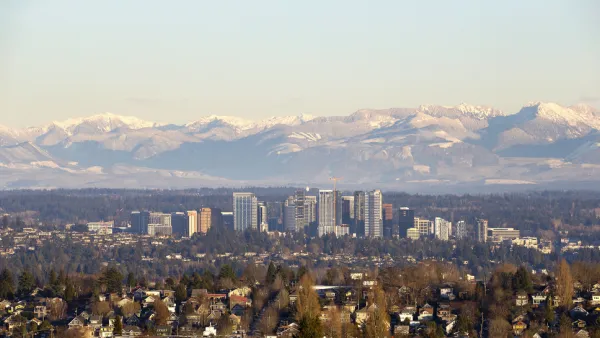
Mapping the Pacific Northwest's Changing Population
The Oregonian has published a new interactive mapping feature that allows users to map demographic changes to the Census tract level through Oregon and Washington.

Analysis Debunks Equity Criticism of Congestion Pricing
Oregon's recently approved gas tax legislation also calls for tolling of I-205 and I-5 in the Portland metro area, with the application of value or congestion pricing so peak period tolls would be higher, which have raised equity concerns.

Desperate measures: Advocates weigh draining Lake Powell to fill Colorado River
Draining the reservoir could reduce evaporation losses by a couple hundred thousand acre-feet.

Eastern Nebraska is running out of electricity
Data centers and electrification are straining eastern Nebraska’s grid, throttling economic development.

Malls are becoming the midtowns of the future
Mall and office park redevelopments are a generational opportunity to create new nodes of urbanity.

NYC breaks ground on anti-flooding infrastructure project
New York City's new system will reduce stormwater flows to local sewers by 90%.

One Kentucky town’s secret to affordable housing
The Smoketown Community Land Trust has already built seven affordable homes for community members.

Houston gains petal-shaped cooling infrastructure to make streets more ‘delightful’
The city has installed the pavilions along 15 blocks in Houston.

FREE Course: Walkable City 1: Why Walkability?
After describing his path towards focusing on walkability as the essence of good planning, Jeff Speck marches through his five principal reasons for making more walkable places.
Reinventing Malls: Planning Alchemy—Turning Gray Fields Into Gold
The course focuses on the opportunities and imperatives that shape reinvention of mall sites.

City of Rosemead
Rutgers University, Edward J. Bloustein School of Planning and Public Policy
One Hundred Miles
University of Michigan School for Environment and Sustainability (SEAS)
Hunter College, City University of New York (CUNY)
The Architects Foundation
City of Cambridge
Montrose County
The Pocatello Development Authority