With New York and the federal government partnering to fund 325 new electric-vehicle charging stations statewide, Dana Rubinstein asks if this investment will be enough to persuade East Coasters to start buying EVs in droves.


If the northeast region's relative lack of interest in electric cars can be attributed to the dreaded "rage anxiety" caused by a lack of charging stations (California currently has 1,200, or a thousand more than New York), than the plan recently announced by Governor Andrew Cuomo could make electric-car ownership in New York "less frightening," writes Rubinstein.
Admittedly, the $4.4 million cost of the project isn't "a particularly large public commitment." But, argues Rubinstein, "it does represent the sort of infrastructure investment that's going to be necessary to popularize electric cars, or at least make them more commercially feasible for manufacturers and, in turn, cheaper for consumers."
"The more chargers you put out there, the more comfortable people are with driving their vehicles longer range," said Colin Read, vice-president for a company that is deploying more than 12,000 chargers nationwide.
"But, he also said, 'In reality we need cars on the road to justify putting chargers out there.'"
Read the full story: With state-funded charging stations, Cuomo gives electric cars a modest push toward critical mass
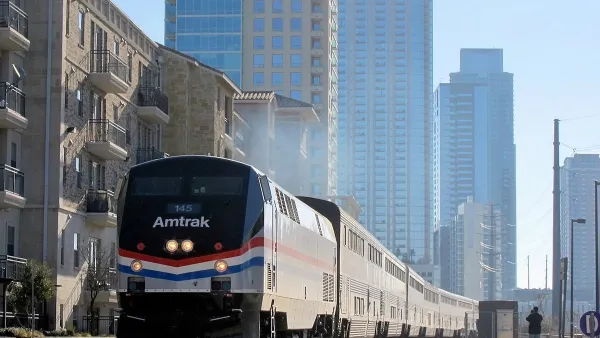
Five Key Transportation Funding Proposals in Trump’s Budget
The President’s proposed 2026 budget would keep spending roughly the same for transit and rail and eliminate over $5 billion in funding for EV charging infrastructure.
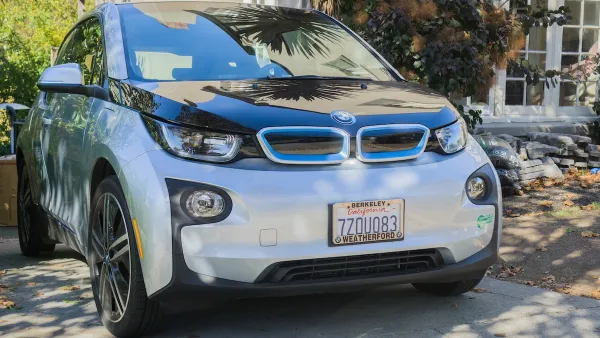
Oakland to Add 244 New EV Chargers
Oakland plans to launch its new charging network at eight locations by the end of 2025.
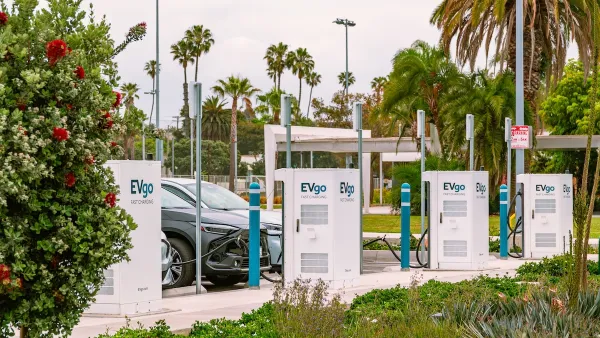
EV Chargers Now Outnumber Gas Pumps by Nearly 50% in California
Fast chargers still lag behind amidst rapid growth.

Desperate measures: Advocates weigh draining Lake Powell to fill Colorado River
Draining the reservoir could reduce evaporation losses by a couple hundred thousand acre-feet.

Eastern Nebraska is running out of electricity
Data centers and electrification are straining eastern Nebraska’s grid, throttling economic development.

Malls are becoming the midtowns of the future
Mall and office park redevelopments are a generational opportunity to create new nodes of urbanity.

NYC breaks ground on anti-flooding infrastructure project
New York City's new system will reduce stormwater flows to local sewers by 90%.

One Kentucky town’s secret to affordable housing
The Smoketown Community Land Trust has already built seven affordable homes for community members.

Houston gains petal-shaped cooling infrastructure to make streets more ‘delightful’
The city has installed the pavilions along 15 blocks in Houston.

FREE Course: Walkable City 1: Why Walkability?
After describing his path towards focusing on walkability as the essence of good planning, Jeff Speck marches through his five principal reasons for making more walkable places.
Reinventing Malls: Planning Alchemy—Turning Gray Fields Into Gold
The course focuses on the opportunities and imperatives that shape reinvention of mall sites.

City of Rosemead
Rutgers University, Edward J. Bloustein School of Planning and Public Policy
One Hundred Miles
University of Michigan School for Environment and Sustainability (SEAS)
Hunter College, City University of New York (CUNY)
The Architects Foundation
City of Cambridge
Montrose County
The Pocatello Development Authority