With cities across the country seeking to find innovative and economical solutions to problems caused by combined sewer systems, could Philly's popular Green City, Clean Waters program be a model worth copying?


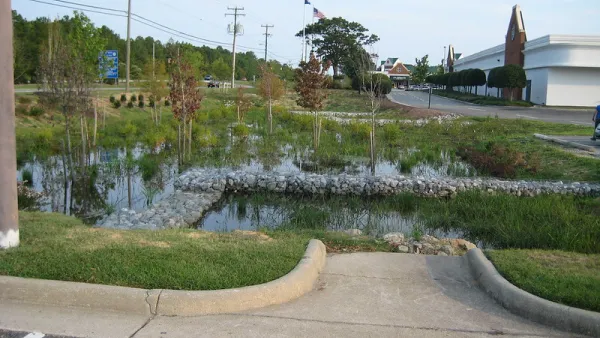
Paul McRandle reports on the city's multifaceted effort "to address the city's storm-water runoff problem, improve streets, benefit the community, and create jobs." Launched in 2010, the Philadelphia Water Department's Green City, Clean Waters program consists of elements such as green roofs, porous paving, storm-water planters, rain gardens, and rain barrels that are intended to protect and enhance the city's watersheds in a more cost-effective way than investing in more "gray infrastructure."
McRandle notes the city's long history of water innovation, which includes "Ben Franklin's swim fins and glass armonica" and the more recent invention of permeable paving by the Franklin Institute in 1977.
With successes so far including the completion of 35 "green street blocks," the removal of 10,000 square feet of impervious paving, and the completion of sixteen green school projects, Green City, Clean Waters is well on its way to claiming its own place in the history books.
Read the full story: Philadelphia Cleans Up Storm Water With Innovative Program
FYI about GSI: The Recipe for Green Stormwater Infrastructure Success
New research highlights some of the ways planners can increase the social benefits and public acceptance of green stormwater infrastructure.
More Funding for Philly’s Urban Watershed Efforts
With the "Green City, Clean Waters" initiative already underway, a recent grant from the U.S. EPA will help Philadelphia evaluate best practices for building and maintaing its urban watershed.

Learning loss and urban schools, part 2
Did test scores in progressive cities drop more post-COVID than test scores in moderate ones?

Planetizen Federal Action Tracker
A weekly monitor of how Trump’s orders and actions are impacting planners and planning in America.

Eastern Nebraska is running out of electricity
Data centers and electrification are straining eastern Nebraska’s grid, throttling economic development.

Washington state to charge fee to drivers with fuel-efficient cars
Revenue from the fee will go towards supporting the state’s highways.

Instead of building new housing, LA developers are turning mansions into mega-mansions
In the richest areas, the number of houses valued at $30 million with demolition permits has skyrocketed since 2018.

Illinois considers spending $1 billion in taxpayer money on data center
A quantum computing campus and data center are currently under construction in Chicago.

As development costs rise, Boston moves to lessen affordable housing requirements
The Boston Zoning Commission and the City Council still need to approve Boston Mayor Michelle Wu’s proposed changes

FREE Course: Walkable City 1: Why Walkability?
After describing his path towards focusing on walkability as the essence of good planning, Jeff Speck marches through his five principal reasons for making more walkable places.
Reinventing Malls: Planning Alchemy—Turning Gray Fields Into Gold
The course focuses on the opportunities and imperatives that shape reinvention of mall sites.

City of Charlotte
City of Rosemead
Rutgers University, Edward J. Bloustein School of Planning and Public Policy
University of Michigan School for Environment and Sustainability (SEAS)
Hunter College, City University of New York (CUNY)
The Architects Foundation
University District Partnership
City of Cambridge
The Pocatello Development Authority