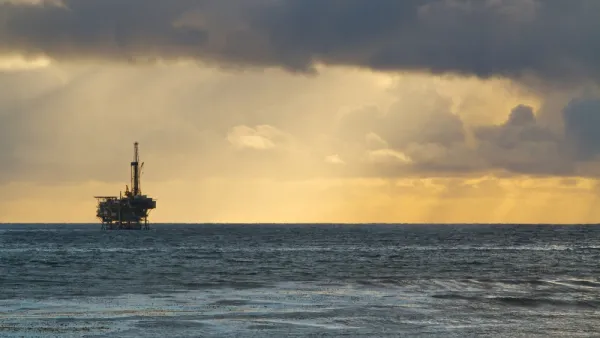
Shell Oil's seven-year, $4 billion investment has paid off. Awaiting final Interior Dept. permits, two drilling ships, moored in Seattle, are poised to travel to the Arctic to begin drilling test wells in 150 ft of water off northern Alaska in July.


In this feature article, John M. Broder and Clifford Krauss look at the conditions, including the legacy of the Exxon Valdez disaster in 1989, that led to Shell Oil's successful pursuit of the right to drill in the fragile Arctic waters. Shell took a different political course than its Big Oil brethren as it set about wooing potential adversaries by "pushing for a strong response to climate changes."
Its biggest obstacle proved not to be President Obama, "under pressure from rising gas prices" nor the mainstream environmental organizations who remain opposed to the effort.
"Frances Beinecke, president of the Natural Resources Defense Council and a member of the National Commission on the Deepwater Horizon Oil Spill and Offshore Drilling characterized the exploration as "a reckless gamble we cannot afford."
The 5,000 Inupiat Eskimos who see the drilling as a threat to their whale-based culture, and their leader, North Slope Borough Mayor Edward S. Itta whose "gravitas grew from his acclaim as one of the area's finest whaling captains", proved to be the greatest obstacle. As Broder writes in his Green blog, these Eskimos are the ones most likely to suffer should there be an oil spill.
"Shell company executives say (the Arctic) could eventually yield a million barrels a day of crude - or more than 10 percent of current domestic output." [U.S. Crude oil plus petroleum products of 8.5 mb/day + natural gas liquids of 2 mb/day.]
As possibly an omen of the difficulties in drilling in the Arctic that await Shell, "the heaviest polar ice in more than a decade is clinging to the northern coast of Alaska could postpone the commencement of offshore oil drilling until the beginning of August", reports the LA Times.
Read the full story: New and Frozen Frontier Awaits Offshore Oil Drilling

$7 Billion Later, Shell to Withdraw from Arctic Oil Drilling
Environmentalists could have saved themselves a lot of demonstrating had they known that Shell Oil would pack up their drilling rigs after only six weeks of exploratory drilling in the Chukchi Sea off Alaska. Insufficient oil and other reasons cited.
President Trump Signs Executive Order to Reverse Obama's Coastal Drilling Ban
So much for that so-called "permanent" ban that President Obama enacted by President Obama in December to end oil and gas drilling in the Arctic Ocean and off the central-northern Atlantic coast.

Shell Gives Another Early Christmas Gift to Environmentalists
Shell Oil surprised the environmental community in September by announcing an end to Arctic drilling. What could come next? Shell is abandoning plans for the Carmon Creek oil-sands project in Alberta and taking a $2 billion write-down.

Planetizen Federal Action Tracker
A weekly monitor of how Trump’s orders and actions are impacting planners and planning in America.

Amtrak, CN end decades-long dispute with eight-year agreement
The new operating agreement establishes an updated framework for the companies to work together, including processes to resolve disputes.

Northwest rail fans eager for Sept. 30 debut of Amtrak’s Airo fleet
Get ready for that new train smell and more seats. But they won’t go faster or run more frequently on the Cascades route in Washington and Oregon.

Newsom kills bill requiring polluting factories near schools to undergo environmental review
In his veto letter, Newsom wrote that protecting communities and strengthening manufacturing “were not mutually exclusive.”

Brightline Florida files for bankruptcy
The transit company is over $5 billion in debt.

St. Louis Metro to test if single-car trains can reduce operating costs, maintain rider satisfaction
The pilot program will run from October to spring 2027, and begin with one single-car train operating on Metrolink’s Red and Blue lines.

FREE Course: Walkable City 1: Why Walkability?
After describing his path towards focusing on walkability as the essence of good planning, Jeff Speck marches through his five principal reasons for making more walkable places.
Reinventing Malls: Planning Alchemy—Turning Gray Fields Into Gold
The course focuses on the opportunities and imperatives that shape reinvention of mall sites.

City of Thousand Oaks
City of Wisconsin Rapids
Harvard University Graduate School of Design
The Architects Foundation
University of Cincinnati Online
The Pocatello Development Authority
The Urban Renewal Agency of the City of Pocatello