Gaia Pianigiani discusses the recent opening of a new, luxury high-speed rail line in Italy – Europe's first private competitor to domestic, state-run HSR.


A new contender on the high-speed rail scene made its maiden voyages Saturday, as Italian travelers boarded the plum-red cars of Italo for 186-mile-an-hour jaunts between Milan and Naples.
Operated by Nuovo Transporto Viaggiatori, Italo caters to the luxury market, offering "free Wi-Fi, satellite television, a 39-seat cinema carriage, leather seats manufactured by the luxury furniture maker Poltrona Frau, and assistance and welcome points in the main stations designed by the team of the Italian architect Stefano Boeri," Pianigiani writes.
"We have brought an end to one of the longest monopolies in the history of our country," said Luca Cordero di Montezemolo, president of NTV. "Finally, Italian travelers and tourists can choose."
While Italians are riding high-speed rail much more now than just three years ago, the company still faces important challenges. "The risk NTV is taking is certainly very high, amplified by Italy's current economic crisis and the improvement of the Italian infrastructure that is still lagging behind," said Oliviero Baccelli of the Center for Research on Regional Economics, Transport and Tourism at Bocconi University. "But high-speed in Italy has very, very significant development margins."
Read the full story: On High-Speed Rails, a New Challenger in Italy

California High-Speed Rail Authority picks trainset manufacturer
The California High-Speed Rail Authority aims to start servicing passengers by 2033.
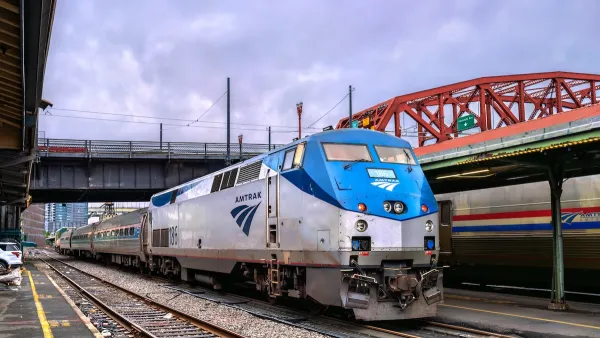
Transit leaders progress high-speed rail from Portland to Vancouver, B.C.
Washington state officials may reveal feasible routes for the high-speed rail in late 2027.

California high-speed rail accomplishes only one legislative goal in 2026
The majority of the agency's failed pitches were never developed into written proposals.

Planetizen Federal Action Tracker
A weekly monitor of how Trump’s orders and actions are impacting planners and planning in America.

Eastern Nebraska is running out of electricity
Data centers and electrification are straining eastern Nebraska’s grid, throttling economic development.

Study reveals best places in the U.S. for cycling, walking
New research from Streetlight Data examines bicycle and pedestrian miles per capita in the 100 largest U.S. cities by population.

DSA members accuse Mamdani of 'abandoning values' over housing redevelopment
New York City's mayor plans to replace about 2,000 units of public housing with private, mixed-income housing.

All sides of BRT debate unhappy with CDOT’s most recent move
The Colorado Department of Transportation is no longer considering center-running bus lanes for Colorado Boulevard.

Massachusetts bogs generate both power, and cranberries
Putting solar panels above farmland is one way Massachusetts is advancing toward its goal of net-zero carbon emissions by 2050.

FREE Course: Walkable City 1: Why Walkability?
After describing his path towards focusing on walkability as the essence of good planning, Jeff Speck marches through his five principal reasons for making more walkable places.
Reinventing Malls: Planning Alchemy—Turning Gray Fields Into Gold
The course focuses on the opportunities and imperatives that shape reinvention of mall sites.

City of Rosemead
Rutgers University, Edward J. Bloustein School of Planning and Public Policy
One Hundred Miles
University of Michigan School for Environment and Sustainability (SEAS)
Hunter College, City University of New York (CUNY)
The Architects Foundation
City of Cambridge
The Pocatello Development Authority
The Urban Renewal Agency of the City of Pocatello