To launch his new 4-part series on walking in Slate, Tom Vanderbilt describes the "public health nightmare" of a country that has forgotten how to walk.


Vanderbilt argues that Americans' lack of familiarity with the most basic mode of locomotion is based largely on their devotion to driving - as well as the fact that walking is taken for granted:
"Even in one of America's most 'pedestrian-friendly' cities-a seemingly innocent phrase that itself suddenly seemed strange to me-one was always in danger of being relegated to a footnote. Which is what walking in America has become: An act dwelling in the margins, an almost hidden narrative running beneath the main vehicular text. Indeed, the semantics of the term pedestrian would be a mere curiosity, but for one fact: America is a country that has forgotten how to walk. [T]he idea that that we, this species that first hoisted itself into the world of bipedalism nearly 4 million years ago-for reasons that are still debated-should now need 'walking tips,' have to make 'walking plans' or use a 'mobile app' to 'discover' walking trails near us or build our 'walking histories,' strikes me as a world-historical tragedy.
...[W]alking has become a lost mode, perceived as not a legitimate way to travel but a necessary adjunct to one's car journey, a hobby, or something that people without cars-those pitiable 'vulnerable road users,' as they are called with charitable condescension-do."
In the next installments, Vanderbilt will examine the science of walking, calculating your walking score, and learning to walk again.
Read the full story: The Crisis in American Walking
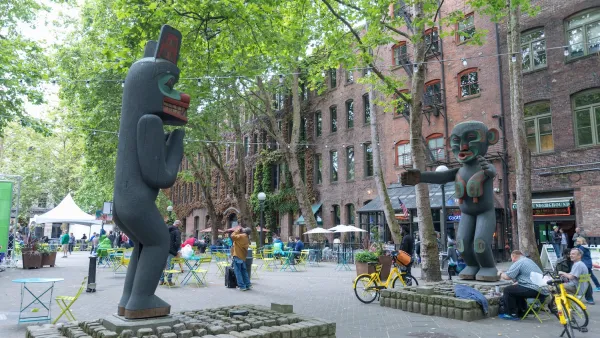
Seattle's Pioneer Square to become pedestrian zone during World Cup
The city will restrict car traffic and street parking in areas around Lumen Field on match days.

Study reveals best places in the U.S. for cycling, walking
New research from Streetlight Data examines bicycle and pedestrian miles per capita in the 100 largest U.S. cities by population.
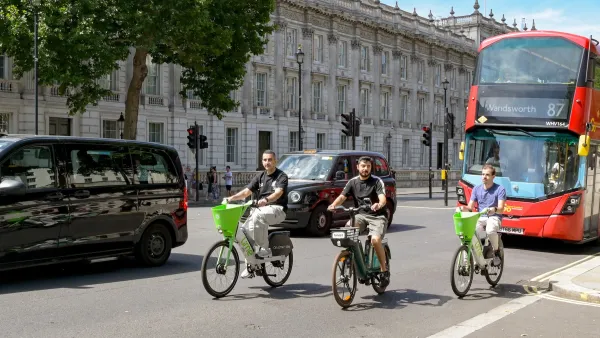
Bike use in London grew by 43% since 2019, but car use remains roughly the same
The city's efforts to reduce car use have stalled despite ambitious programs like congestion pricing and low-traffic neighborhoods.

Eastern Nebraska is running out of electricity
Data centers and electrification are straining eastern Nebraska’s grid, throttling economic development.

Move over, LA: St. Louis gears up for Olympics, invests millions in downtown redevelopment
The Missouri city will host the 2028 Olympic soccer group stage and knockout matches.
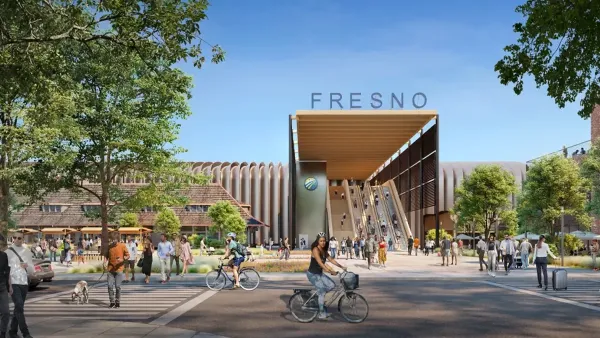
California High-Speed Rail Authority picks trainset manufacturer
The California High-Speed Rail Authority aims to start servicing passengers by 2033.

Dallas releases zoning code overhaul to officials
The drafted overhaul is over 400 pages long.

NYC renovations for dangerous, ‘mercilessly crammed’ street delayed until 2027
Construction was supposed to begin this fall.

San Diego’s Midway Rising project gets greenlight from city council
The project looks to become the largest affordable housing development in California's history.

FREE Course: Walkable City 1: Why Walkability?
After describing his path towards focusing on walkability as the essence of good planning, Jeff Speck marches through his five principal reasons for making more walkable places.
Reinventing Malls: Planning Alchemy—Turning Gray Fields Into Gold
The course focuses on the opportunities and imperatives that shape reinvention of mall sites.

City of Rosemead
Rutgers University, Edward J. Bloustein School of Planning and Public Policy
One Hundred Miles
University of Michigan School for Environment and Sustainability (SEAS)
Hunter College, City University of New York (CUNY)
The Architects Foundation
City of Cambridge
The Pocatello Development Authority
The Urban Renewal Agency of the City of Pocatello