Treasury Secretary Ray LaHood warned Congress that according to a recent Congressional Budget Office report, the Highway Trust Fund will be broke come fiscal year 2014, due largely to more fuel-efficient vehicles and less driving.


The Hill blog fails to mention the failure of the federal government to raise the gas tax, the main revenue source of the trust fund, unchanged since 1993, as a reason for its approaching bankruptcy.
"The federal gas tax, which is currently 18.4 cents per gallon, brings in approximately $100 million per day in revenue. But Lawmakers in Congress are discussing a new highway bill which in the Senate would spent between $13 and $14 billion per year more than the $36 billion the gas tax brings in annually."
Each party has a different idea for how to make up the difference in gas tax revenues and projected transportation spending. For Democrats, "That's why the president talked about a transportation bill and a jobs bill, he talked about using some of the money from the two (Iraq and Afghanistan) wars," stated LaHood.
For Republicans, The House transportation bill, proposes to make up the difference with new gas and oil drilling royalties (some of which would flow from the proposed Keystone Pipeline project).
Thanks to Mark Boshnack
Read the full story: CBO reports highway trust fund headed for bankruptcy in 2014
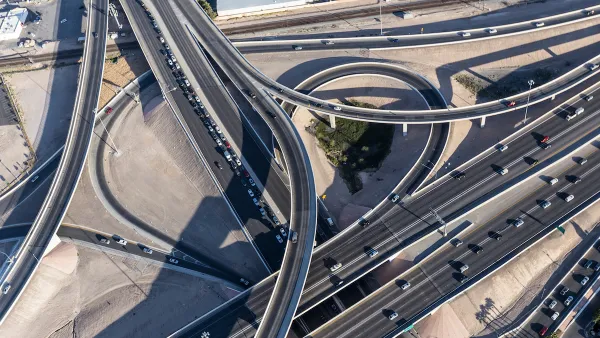
Restoring Solvency to the Highway Trust Fund
The Highway Trust Fund, the nation's source of road and bridge funding, went bankrupt in 2008 and has since relied on transfers from the General Fund to supplement fuel taxes. Republican Senators have proposed a new funding source: an EV fee.
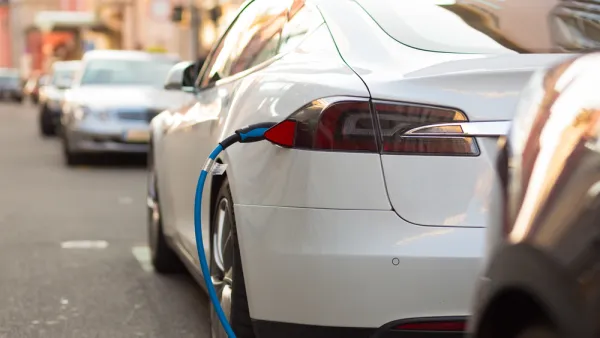
Federal Lawmakers Target Electric Vehicles in Transportation Reauthorization
How will motorists who don't pay gas taxes fund road upkeep? That's one of the questions that the Senate Environment & Public Works Committee hopes to answer this summer as they work to reauthorize the FAST Act before it expires on Sept. 30, 2020.
Pelosi-Schumer-Trump Infrastructure Plan Already Meeting Resistance
Introduced on April 30, the $2 trillion conceptual plan is likely to be dismissed by Congressional Republicans wary of increasing taxes and adding to the deficit, according to an extensive article by The Hill published three days later.

Planetizen Federal Action Tracker
A weekly monitor of how Trump’s orders and actions are impacting planners and planning in America.

California plans to bury El Niño’s downpour
If the state plays its cards right, it may be able to store a billion acre-feet of El Niño’s water in aquifers.

Desperate measures: Advocates weigh draining Lake Powell to fill Colorado River
Draining the reservoir could reduce evaporation losses by a couple hundred thousand acre-feet.

Chicago voters approve permanent festival grounds, penalty for vacant property owners
Currently, major summer and fall festivals take over public parks for weeks at a time, drawing criticism from nearby residents

NYC votes to cut outdoor dining red tape, speed up permitting
New York City also voted to allow the Department of Transportation to begin work on urgent projects before notifying elected officials.

California appears to reject Prop. 45
The proposition would have expanded the projects that qualify for a streamlined environmental review, effectively paring down the California Environmental Quality Act.

FREE Course: Walkable City 1: Why Walkability?
After describing his path towards focusing on walkability as the essence of good planning, Jeff Speck marches through his five principal reasons for making more walkable places.
Reinventing Malls: Planning Alchemy—Turning Gray Fields Into Gold
The course focuses on the opportunities and imperatives that shape reinvention of mall sites.

City of Rosemead
Rutgers University, Edward J. Bloustein School of Planning and Public Policy
One Hundred Miles
Hunter College, City University of New York (CUNY)
The Architects Foundation
University of Cincinnati Online
City of Cambridge
Montrose County
The Pocatello Development Authority