






















Gabriel Roth, a civil engineer, transportation economist and research fellow is fed up with the federal government's inability to fully fund transportation and suggests that its time to hand off responsibility to the states.


Roth, writing for The Independent Institute in Oakland, CA, observes that neither of the two congressional bills to reauthorize the transportation funding bill are fully funded by fuel tax revenues and will need subsidy by the U.S. general fund (or some non-user fund source). He is frustrated by what he terms the "new (funding) principle (that) has brought the United States to the brink of insolvency: Spend what you want and if the usual funding sources aren't sufficient - in this case the fuel taxes that replenish the trust fund - dip into general revenues to make up the difference."
"(T)here is a solution to the funding dilemma: Congress could get out of transportation financing altogether, wind down the Highway Trust Fund and leave highway financing and decision-making to states, local authorities and private entities."
Roth supports his solution with three reasons, including relieving Congress of doing what appears to be politically impossible but completely necessary: raising fuel taxes. However, Roth shows himself to be no friend of transit.
"Under this arrangement, transit users and providers would lose their federal subsidies. Mass transit, which comprises less than 2 percent of U.S. urban travel-miles, currently receives 20 percent of federal surface transportation funding. But transit projects should be funded locally, not by Washington. Why should farmers in Ohio finance mass transit services in Chicago?"
FULL STORY: Gabriel Roth: Who should pay for highways?

Restoring Solvency to the Highway Trust Fund
The Highway Trust Fund, the nation's source of road and bridge funding, went bankrupt in 2008 and has since relied on transfers from the General Fund to supplement fuel taxes. Republican Senators have proposed a new funding source: an EV fee.
Federal Lawmakers Target Electric Vehicles in Transportation Reauthorization
How will motorists who don't pay gas taxes fund road upkeep? That's one of the questions that the Senate Environment & Public Works Committee hopes to answer this summer as they work to reauthorize the FAST Act before it expires on Sept. 30, 2020.
Pelosi-Schumer-Trump Infrastructure Plan Already Meeting Resistance
Introduced on April 30, the $2 trillion conceptual plan is likely to be dismissed by Congressional Republicans wary of increasing taxes and adding to the deficit, according to an extensive article by The Hill published three days later.

Planetizen Federal Action Tracker
A weekly monitor of how Trump’s orders and actions are impacting planners and planning in America.
Chicago’s Ghost Rails
Just beneath the surface of the modern city lie the remnants of its expansive early 20th-century streetcar system.
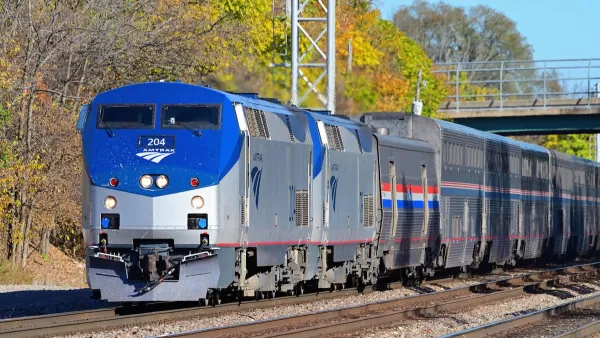
Amtrak Cutting Jobs, Funding to High-Speed Rail
The agency plans to cut 10 percent of its workforce and has confirmed it will not fund new high-speed rail projects.

Ohio Forces Data Centers to Prepay for Power
Utilities are calling on states to hold data center operators responsible for new energy demands to prevent leaving consumers on the hook for their bills.

MARTA CEO Steps Down Amid Citizenship Concerns
MARTA’s board announced Thursday that its chief, who is from Canada, is resigning due to questions about his immigration status.

Silicon Valley ‘Bike Superhighway’ Awarded $14M State Grant
A Caltrans grant brings the 10-mile Central Bikeway project connecting Santa Clara and East San Jose closer to fruition.

Urban Design for Planners 1: Software Tools
This six-course series explores essential urban design concepts using open source software and equips planners with the tools they need to participate fully in the urban design process.
Planning for Universal Design
Learn the tools for implementing Universal Design in planning regulations.

Caltrans
City of Fort Worth
Mpact (founded as Rail~Volution)
City of Camden Redevelopment Agency
City of Astoria
City of Portland
City of Laramie