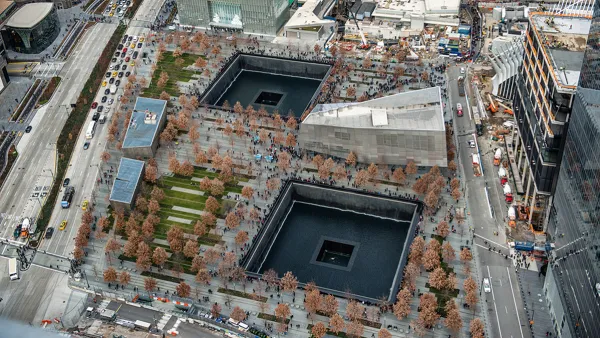
Erica Stewart of the National Trust for Historic Preservation runs down a few of the ways that rebuilding efforts after the attacks on 9/11 took historic preservation into account.


Stewart explains that elements of the World Trade Center were preserved, and the Pentagon was thoughtfully rebuilt:
"Thanks to the Department of Defense, skilled contractors labored tirelessly to rebuild the damaged wing of the Pentagon using material, design and craftsmanship that reflect its National Historic Landmark status. A beautiful memorial has also been constructed on the site of the crash. With help from federal programs like the now-defunct Save America's Treasures, meaningful ties to the World Trade Center have been saved, including the Survivors' Staircase (a 2006 11 Most Endangered listing and a 2009 Honor Award winner) and a 1:200 scale model of the complex."
Stephanie Meeks, President of the National Trust, also makes a statement in the article about the importance of historic preservation on 9/11.
Read the full story: Preservation and Memory
How 9/11 Inspired Public Service as an Urban Planner
The account of how the terror and tragedy of 9/11 led an urban planner from working for a private consulting firm to working in the public sector.
The City Planner Behind 9/11
Mohamed Atta, one of the 9/11 terrorists, pursued a masters degree in city planning before the attacks. Slate's Daniel Brooks reads Atta's masters thesis, and finds a strain of anti-Western modernism that is revealing.

20 Years After 9/11: The 'Age of Skyscrapers' Is Nowhere Near Over
Despite predictions that the events of September 11, 2001 would be the end of skyscrapers, U.S. cities are building more tall buildings than ever.

Planetizen Federal Action Tracker
A weekly monitor of how Trump’s orders and actions are impacting planners and planning in America.

Eastern Nebraska is running out of electricity
Data centers and electrification are straining eastern Nebraska’s grid, throttling economic development.

California High-Speed Rail Authority picks trainset manufacturer
The California High-Speed Rail Authority aims to start servicing passengers by 2033.

States are counting on battery farms. Some towns don’t want them.
While fire safety has improved, some communities are still wary.

Dallas releases zoning code overhaul to officials
The drafted overhaul is over 400 pages long.

NYC renovations for dangerous, ‘mercilessly crammed’ street delayed until 2027
Construction was supposed to begin this fall.

FREE Course: Walkable City 1: Why Walkability?
After describing his path towards focusing on walkability as the essence of good planning, Jeff Speck marches through his five principal reasons for making more walkable places.
Reinventing Malls: Planning Alchemy—Turning Gray Fields Into Gold
The course focuses on the opportunities and imperatives that shape reinvention of mall sites.

City of Rosemead
Rutgers University, Edward J. Bloustein School of Planning and Public Policy
One Hundred Miles
University of Michigan School for Environment and Sustainability (SEAS)
Hunter College, City University of New York (CUNY)
The Architects Foundation
City of Cambridge
The Pocatello Development Authority
The Urban Renewal Agency of the City of Pocatello