Smart Growth opponent Wendell Cox clamors that land use regulations imposed by Smart Growth exacerbate the ongoing housing woes.


Matthew Strozier of the Wall Street Journal covers a report by Cox for the National Center for Policy Analysis, in which Cox argues that "[t]he housing price bubble was concentrated in areas with restrictive land use policies."
Strozier summarizes the report: "Mr. Cox argues that the housing bust was concentrated in 'prescriptively regulated' areas, or those with extensive barriers to development. These differ from 'responsively regulated' metro areas, which allow development to meet demand."
Patrick Phillips of the Urban Land Institute is brought in to represent the pro-smart growth side. He says, "...it's specious to pin the housing bubble on smart growth."
FULL STORY: Did Smart Growth Fuel the Property-Price Boom?

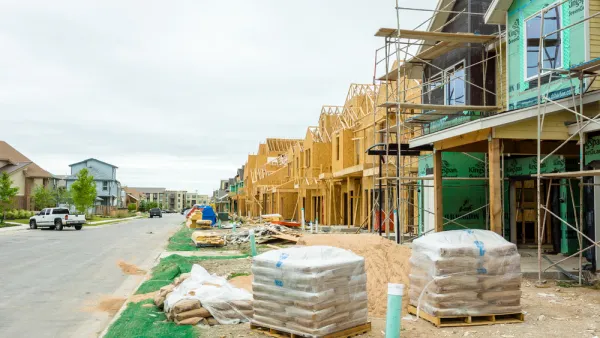
The Housing Affordability Recipe
Smart policies can ensure that low- and moderate-income households can find suitable housing in good neighborhoods where transportation costs are low. The research is clear: upzoning works.
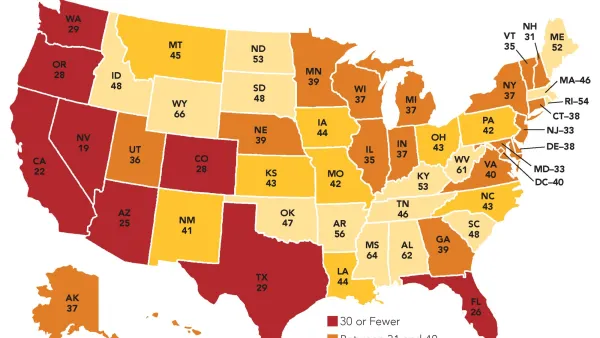
Distinguishing the Housing Shortage from Gentrification
Gentrification "mutates particular neighborhoods" while scarce housing "squeezes entire regions," Devin Michelle Bunten writes. Conflating the two can lead to inaccuracies in understanding.

Vancouver's New 10-Year Housing Strategy Focuses on Rentals
Vancouver is famous for high-rises and a decidedly urban quality of life, but housing prices are still skyrocketing. A new ten-year housing strategy proposes a few drastic measures to rebalance the market's scales.

The state-sanctioned urbicide of Austin
People don’t kill cities. Freeways do.

US to reduce Colorado River water deliveries to Mexico
A new Colorado Treaty amendment reduces Mexico’s Colorado River water allocation by 250,000 acre feet.

New Jersey’s second-largest city bans standalone data centers
Jersey City will continue to allow co-location facilities, such as those meant for research institutions that store their own data.

Amtrak not solely to blame for New Jersey commuter rail's unreliability, report finds
A new study from the Garden State Initiative found that NJ Transit’s budget grew 20% across a 4 year period, but reliability declined significantly over the same period.

EPA erases limits on planet-warming pollution from power plants
Under Monday’s plan, power plants would still have some limits on how much mercury, arsenic and other contaminants they can emit.

Phoenix announces new on-demand transit service, more frequent RAPID buses
Both new services will launch in October, and are part of Phoenix's Project Effective Access Solutions for Easing Congestion.

FREE Course: Walkable City 1: Why Walkability?
After describing his path towards focusing on walkability as the essence of good planning, Jeff Speck marches through his five principal reasons for making more walkable places.
Reinventing Malls: Planning Alchemy—Turning Gray Fields Into Gold
The course focuses on the opportunities and imperatives that shape reinvention of mall sites.

Eagle County Government
Harvard University Graduate School of Design
Nashville Planning Department
The Architects Foundation
University of Cincinnati Online
The Pocatello Development Authority
The Urban Renewal Agency of the City of Pocatello
Journal of the American Planning Association