A 4-year legal battle over whether SF's bike plan was in compliance with the state's environmental law has been settled - the city has the go-ahead to resume planning and implementing new bike facilities designed to increase bike riding.


Perhaps more than any other lawsuit based on the California Environmental Quality Act, the suspension of San Francisco's bike plan on the basis that the city had not prepared an Environmental Impact Report showing the impact that bike lanes would have on vehicle parking and traffic revealed how this 4-decade old law may be easily misused in terms of the urban landscape.
On Friday, August 6, "Judge Peter J. Busch found the city in compliance with court-required environmental reviews of traffic and parking issues.
The decision lifts a 2006 court ban against implementation of the San Francisco Bicycle Plan and allows the city to move forward immediately on 35 bike projects. The bike plan called for adding 34 miles of bike lanes to the existing 45 miles."
"Today is the beginning of a new era for bicycling in San Francisco," Nathaniel Ford, executive director of the San Francisco Municipal Transportation Agency, said Friday."
Thanks to Paul Metz
Read the full story: Ruling paves way for San Francisco bike lanes

The Potential Downside of Railroad Electrification—for Motorists
Electrification of the Caltrain will be great for train riders, the environment, air quality, and public health, but it might worsen traffic congestion between San Jose and San Francisco by increasing the frequency of commuter trains.
Progress for San Francisco's Ambitious Bike Plans
Ariel Rosenstock updates San Francisco's progress in implementing the vision set forth by the 2009 San Francisco Bicycle Plan.
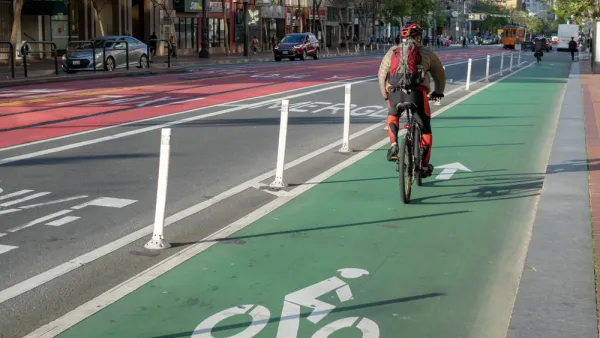
San Francisco's New Bike Lane Experience
The city of San Francisco has been overhauling its bike infrastructure during the pandemic. The results are especially apparent in the city's downtown.

Planetizen Federal Action Tracker
A weekly monitor of how Trump’s orders and actions are impacting planners and planning in America.

Amtrak, CN end decades-long dispute with eight-year agreement
The new operating agreement establishes an updated framework for the companies to work together, including processes to resolve disputes.

Judges permit Denver to divert 77,000 acre feet from the Colorado River for reservoir expansion
Overuse and climate change have caused the Colorado River’s water levels to plummet.

NYC DOT wants faster, more permanent street upgrades
The city is examining ways to build more concrete infrastructure without getting entangled in 'decades-long' projects.

'Something we’ve never seen before:' rising utility rates could strain city finances nationwide
Data centers, climate change and other factors have caused utility rates in the United States to increase by 38% since 2020.

Trump to overrule local leaders, lease millions of acres of America’s Pacific Island territories’ seafloors to mining companies
International law says that the Indigenous people of America’s territories have a right to prior and informed consent regarding projects that impact their countries.

FREE Course: Walkable City 1: Why Walkability?
After describing his path towards focusing on walkability as the essence of good planning, Jeff Speck marches through his five principal reasons for making more walkable places.
Reinventing Malls: Planning Alchemy—Turning Gray Fields Into Gold
The course focuses on the opportunities and imperatives that shape reinvention of mall sites.

Harvard University Graduate School of Design
KFH Group Inc.
Greater Baltimore Committee
The Architects Foundation
University of Cincinnati Online
The Pocatello Development Authority
The Urban Renewal Agency of the City of Pocatello