Harvard economics professor Edward L. Glaeser argues that the United States has a long, pervasive pattern of anti-urban behavior that needs to change.


Glaeser writes, "Over the past 60 years, cities have been hit by a painful policy trifecta: subsidization of highways, subsidization of homeownership, and a school system that creates strong incentives for many parents to leave city borders. Nathaniel Baum-Snow, an economist at Brown University, has documented that each new federally-funded 'highway passing through a central city reduces its population by about 18 percent.'"
Glaeser goes on to argue that subsidizing homeownership is also anti-urban, benefiting suburban single-family homes over city apartments, and that educational policy has driven families out of inner cities in search of higher quality schools.
Interestingly, Glaeser also says that funding for trains is also anti-urban, because it "decreases the advantage of living close together in cities."
Read the full story: Why the anti-urban bias?


Resilience Planning for Suburban Growth
Whether or not the suburban shift accelerated by the pandemic continues, policymakers can implement climate resilience strategies and guide sustainable growth in both cities and exurbs.
Census Data: Black Americans Leaving Cities for Suburbs
The trend of Black Americans leaving urban areas for suburban communities mirrors the White Flight of the mid-20th century but for vastly different reasons and with vastly different consequences.
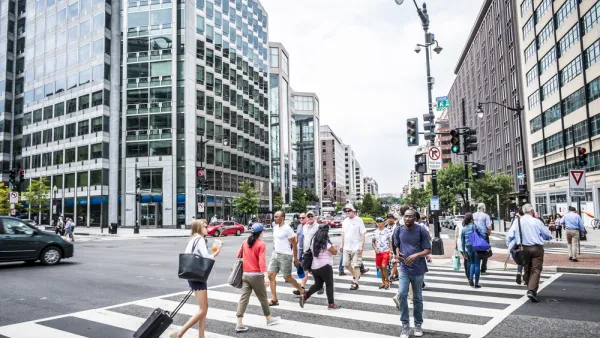
COVID-19 and Big, Dense Cities That Aren't New York
As in metropolitan New York, big, dense cities don't always suffer from coronavirus to a greater extent than their car-oriented suburbs.

Planetizen Federal Action Tracker
A weekly monitor of how Trump’s orders and actions are impacting planners and planning in America.

Amtrak, CN end decades-long dispute with eight-year agreement
The new operating agreement establishes an updated framework for the companies to work together, including processes to resolve disputes.

Northwest rail fans eager for Sept. 30 debut of Amtrak’s Airo fleet
Get ready for that new train smell and more seats. But they won’t go faster or run more frequently on the Cascades route in Washington and Oregon.

NYC to turn city-owned property into thousands of homes
The city has scheduled a public hearing regarding the development for October.

Buses travel at 5mph along this route in NYC. The Bronx's first-ever busway looks to change that
Prior to the busway, buses on the Bx36 route traveled as slowly as 5 miles per hour.

Pittsburg launches 'EZ permits,' aims for one-day turnaround for low-risk permits
The pilot ‘fast lane’ for permits is part of a bundle of modernization efforts for Pittsburg’s permitting process.

FREE Course: Walkable City 1: Why Walkability?
After describing his path towards focusing on walkability as the essence of good planning, Jeff Speck marches through his five principal reasons for making more walkable places.
Reinventing Malls: Planning Alchemy—Turning Gray Fields Into Gold
The course focuses on the opportunities and imperatives that shape reinvention of mall sites.

City of Thousand Oaks
City of Wisconsin Rapids
Harvard University Graduate School of Design
The Architects Foundation
University of Cincinnati Online
The Pocatello Development Authority
The Urban Renewal Agency of the City of Pocatello