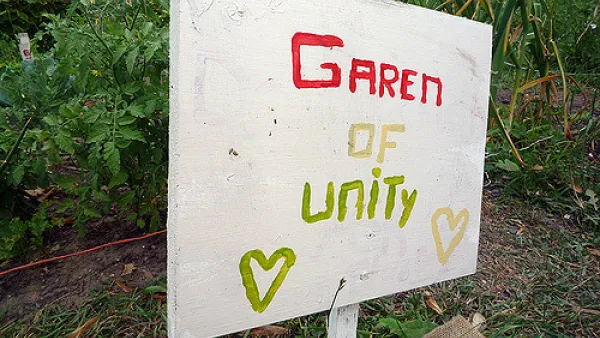
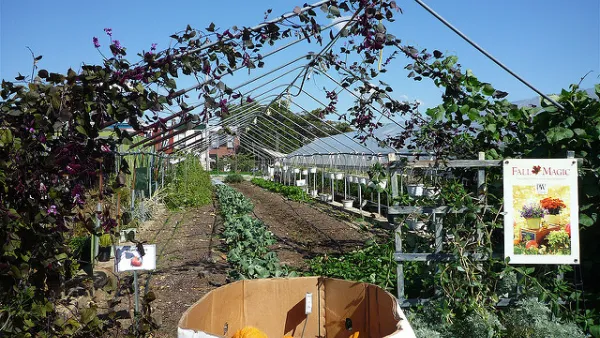
Activists in Seattle have created a community garden on empty land to help provide food for the city's needy.


"The Beacon Hill site is the first of what Alleycat Acres hopes will be many such volunteer-run gardens throughout Seattle, mostly in areas whose residents lack access to healthy produce. The effort is among a growing urban-farming movement nationwide, including Seattle, where city officials have named 2010 'the year of urban agriculture.'
Ultimately, Alleycat envisions running such gardens as community-supported agriculture outfits - known as CSAs - in which low-income residents would pay not on a traditional monthly basis but on a more affordable weekly, sliding-scale basis. The group hopes to take its green efforts one step further by using bicycles to deliver the fruits and vegetables of its labor to those residents - hence the name Alleycat, a term used by bike messengers."
New plots of land are already being offered by locals fro re-use as community gardens.
Read the full story: Breaking ground on an urban farm for the needy on Beacon Hill
No Connection Between Gardens and Gentrification in Detroit, Study Says
Research from late 2021 documented the footprint of urban gardens in Detroit, finding evidence of inequities but not gentrification.
Development Boom Threatens Philadelphia’s Urban Agriculture
As land values rise, more than 200 community gardens in Philadelphia could be lost to redevelopment.
Urban Farming—Just for the Few?
Urban agriculture likely has more social than material impacts. But who does it benefit most?

Desperate measures: Advocates weigh draining Lake Powell to fill Colorado River
Draining the reservoir could reduce evaporation losses by a couple hundred thousand acre-feet.

Eastern Nebraska is running out of electricity
Data centers and electrification are straining eastern Nebraska’s grid, throttling economic development.

Malls are becoming the midtowns of the future
Mall and office park redevelopments are a generational opportunity to create new nodes of urbanity.

NYC breaks ground on anti-flooding infrastructure project
New York City's new system will reduce stormwater flows to local sewers by 90%.

One Kentucky town’s secret to affordable housing
The Smoketown Community Land Trust has already built seven affordable homes for community members.

Houston gains petal-shaped cooling infrastructure to make streets more ‘delightful’
The city has installed the pavilions along 15 blocks in Houston.

FREE Course: Walkable City 1: Why Walkability?
After describing his path towards focusing on walkability as the essence of good planning, Jeff Speck marches through his five principal reasons for making more walkable places.
Reinventing Malls: Planning Alchemy—Turning Gray Fields Into Gold
The course focuses on the opportunities and imperatives that shape reinvention of mall sites.

City of Rosemead
Rutgers University, Edward J. Bloustein School of Planning and Public Policy
One Hundred Miles
University of Michigan School for Environment and Sustainability (SEAS)
Hunter College, City University of New York (CUNY)
The Architects Foundation
City of Cambridge
Montrose County
The Pocatello Development Authority