This piece from Utne Reader looks at the role of architecture in the public works projects of Medellin, Colombia, a city that has struggled with severe crime.


Former Medellín mayor Sergio Fajardo talks about how design and architecture affected the city's safety and psychology.
"As we reported in November, during Fajardo's term as mayor (from 2004 through 2007), any reduction in violence was immediately supplemented with a 'concrete community improvement.' So as Medellín's murder rate plunged, many of the city's poorest neighborhoods became home to sparkling new schools, housing, community spaces, and "library parks" (the Parque Biblioteca España, designed by Mazzanti, is pictured above, at left).
'From the time I was a child, it was clear to me what aesthetics meant as a tool for social transformation, as a message of inclusion,' Fajardo, whose father was an architect, tells Mazzanti. 'That is something that is often misunderstood here. Underneath it all is the most important word in all of those urban interventions in which architecture plays an important role: dignity.'"
Read the full story: How Architecture Transformed a Violent City
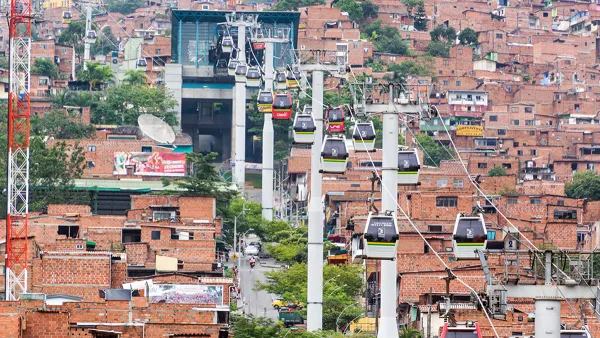
Infrastructure Investment for Public Safety: Lessons from Medellín
A natural experiment in Medellín indicates that infrastructural investments can reduce crime and improve perceptions of public safety.
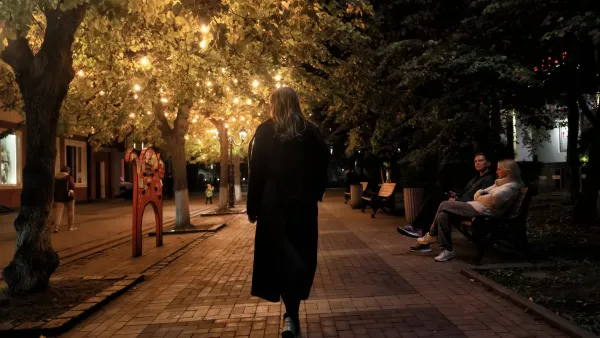
How urban design can deter crime
Well-designed public spaces and good lighting can prevent crime and make residents feel safer.
Red Cities, Blue Cities and (Property) Crime: A Sequel
Like urban violent crime, urban property crime is often a political football. Republicans claim that crime in Democrat-run cities is proof that Democrats are incapable of maintaining public order. Do they have a point?

Desperate measures: Advocates weigh draining Lake Powell to fill Colorado River
Draining the reservoir could reduce evaporation losses by a couple hundred thousand acre-feet.

Eastern Nebraska is running out of electricity
Data centers and electrification are straining eastern Nebraska’s grid, throttling economic development.

Malls are becoming the midtowns of the future
Mall and office park redevelopments are a generational opportunity to create new nodes of urbanity.

NYC breaks ground on anti-flooding infrastructure project
New York City's new system will reduce stormwater flows to local sewers by 90%.

One Kentucky town’s secret to affordable housing
The Smoketown Community Land Trust has already built seven affordable homes for community members.

Houston gains petal-shaped cooling infrastructure to make streets more ‘delightful’
The city has installed the pavilions along 15 blocks in Houston.

FREE Course: Walkable City 1: Why Walkability?
After describing his path towards focusing on walkability as the essence of good planning, Jeff Speck marches through his five principal reasons for making more walkable places.
Reinventing Malls: Planning Alchemy—Turning Gray Fields Into Gold
The course focuses on the opportunities and imperatives that shape reinvention of mall sites.

City of Rosemead
Rutgers University, Edward J. Bloustein School of Planning and Public Policy
One Hundred Miles
University of Michigan School for Environment and Sustainability (SEAS)
Hunter College, City University of New York (CUNY)
The Architects Foundation
City of Cambridge
Montrose County
The Pocatello Development Authority