Human-scaled, creative development isn't getting built because most of the money in real estate comes from institutional investors that prefer predictable, large scale projects like subdivisions and strip malls, says Neil Takemoto of CoolTown Beta Communities.


Why is it that the vast majority of new development is at an institutional scale, and we don't see human-scaled fine-grained urban fabric, the kind that makes historic neighborhoods so desirable? Well, it's mainly because the vast majority of real estate development investment dollars come from institutional investors, and where does that money come from? Your pension and insurance dollars are sourcing this tremendous pool of capital that has to be invested somewhere. To those investment managers with billions to manage, why manage fifty projects if you can manage only ten instead? That simply means they'll prefer investing no less than $5 million at a time, which translates to $15 million projects. That precludes most every single human-scaled building you'd find, explaining why human-scaled neighborhoods weren't built since the 1920s, leaving only large-scale strip malls, subdivisions, office buildings
The thing is, the emerging you-centric market is demanding customized and personal, not mass-produced and commoditized. So how in the world is the supply of investment capital going to accommodate this? By focusing on the long tail - which is essentially anything and everything else that's a 'non-hit' or 'non-blockbuster', but in sum is greater. The good news is that it's inevitable - witness the rise of Netflix instead of Blockbuster; Amazon/eBay/iTunes instead of Wal-Mart; YouTube instead of TV, all of which focus on the thousands of individual niches of smaller interests that are in sum greater than the only the most popular interests. All that was missing was a reliable system of delivery.
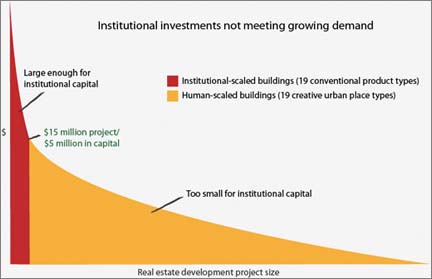
So, the long tail of real estate development - the $1 million to $5 million investments that none of today's major investors want any part of (just like the 42 million video titles Blockbuster won't carry) - will eventually inspire a system to invest in human-scaled buildings in human-scaled neighborhoods once again, just like Netflix devised a system allowing people to rent any one of those 42 million of ‘unwanted' videos. To get a better understanding of why real estate management isn't quite there yet, see 'Why placemaking isn't crowdsourced... yet.'
As you can see in the long tail diagram above, institutional investors aren't interested in development projects costing less than $15 million, which on average require about $5 million of their capital. When you're managing billion dollar funds, anything less than $5 million is too small. However, you can also see that the market demand in the growing knowledge economy is largely left out. Read about the 19 conventional product types of the industrial age vs the 19 urban development/place types of the knowledge age here.
In other words, while many of us would rather live in a multi-unit rowhouse type of building, our only choices may be apartment towers, because only the latter is big enough to finance in today's investment world. The tipping point is too high, and the result is a de facto built environment of monumental projects like you'll find at GlobeSt.com, the de facto real estate investment news site.
Hopefully sooner than later, but inevitably, the investment industry will cater to the long tail (ie the masses, or 'everybody else') and establish contemporary management structures that can handle a greater number of smaller development projects, as low as $6 million requiring $2 million in capital (ie a multi-unit rowhouse) - see diagram below. At the same time, crowdfunding will provide more financing options from the other end, letting the market finance their own preferences. That's when you'll finally see the 19 more creative urban development/place types define the new quality of life that creatives demand.
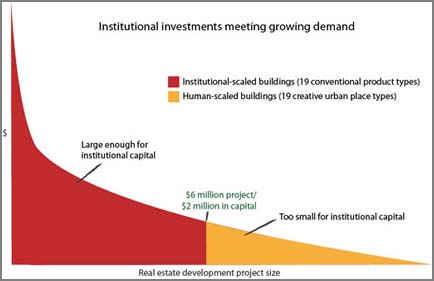
In other words, next generation investors will work with certified developers to buy several smaller buildings at once, provide them with progressive tenants upfront via such contemporary methodologies as crowdsourcing, and enjoy a much greater return (financially as well as socially and environmentally) than if they invested the same amount in one 'GlobeSt.com project'.
Neil Takemoto is the founding director of CoolTown Beta Communities, a crowdsource-based placemaking and economic development firm codeveloping natural cultural districts with creatives.See the original source for this article, Moving the tipping point for creative places, at www.cooltownstudios.com. Thanks to Jamal Williams of Red Dove for contributing to this entry.

Data center developer offers over $4M per acre to buy out homeowners
Data center builders are outbidding home builders for land, prompting concerns about competition with housing.
Zillow Deleted Climate Risk From California Listings. This Climate Expert Wants to Bring it Back.
While difficult to estimate for individual homes, experts argue that home buyers should have access to data about flood and wildfire risk, extreme heat, and other climate hazards in the area.
The Rise of Crowdfunded Real Estate
Enabled by provisions in the JOBS Act of 2012 that allow smaller scale investing, community members are becoming co-owners of local real estate projects.

Planetizen Federal Action Tracker
A weekly monitor of how Trump’s orders and actions are impacting planners and planning in America.

Amtrak, CN end decades-long dispute with eight-year agreement
The new operating agreement establishes an updated framework for the companies to work together, including processes to resolve disputes.

Northwest rail fans eager for Sept. 30 debut of Amtrak’s Airo fleet
Get ready for that new train smell and more seats. But they won’t go faster or run more frequently on the Cascades route in Washington and Oregon.

Trump administration unlawfully slashed $7 billion in clean energy grants, judge rules
The Environmental Protection Agency ended the Solar For All program, which provided the grants, after President Donald Trump’s inauguration.

Record-breaking wildlife overpass in Colorado brings 91% reduction in animal collisions
Prior to the overpass, vehicles were hitting one deer per day on Colorado’s Interstate 25.

California lawmakers approve just 5% of much-needed LA28 transportation funding
State legislators appear just as unwilling as Trump to pay for Olympics-related transportation projects.

FREE Course: Walkable City 1: Why Walkability?
After describing his path towards focusing on walkability as the essence of good planning, Jeff Speck marches through his five principal reasons for making more walkable places.
Reinventing Malls: Planning Alchemy—Turning Gray Fields Into Gold
The course focuses on the opportunities and imperatives that shape reinvention of mall sites.

City of Thousand Oaks
City of Wisconsin Rapids
Harvard University Graduate School of Design
The Architects Foundation
University of Cincinnati Online
The Pocatello Development Authority
The Urban Renewal Agency of the City of Pocatello

