Japan wants to end its spending on wasteful construction projects, which are the cause of the country's massive debt. But for one small town on the verge of losing a dam, the "wasteful" project is the center of the local economy.


"The Democratic Party government of Prime Minister Yukio Hatoyama has chosen this dam as the first of 48 national government-financed dams that it wants to scrap, worth tens of billions of dollars. Canceling it is widely seen here as the first major test of the new government's ability to deliver on campaign promises to revitalize Japan's ailing economy by ending wasteful projects, and in the process break the grip of the central planners in Tokyo's powerful ministries.
Decades of pouring concrete have been widely blamed in Japan for cluttering rural areas with needless dams and roads to nowhere. They have also saddled the country with the developed world's largest national debt - nearly twice its $5 trillion economy. Mr. Hatoyama's party has vowed to replace Japan's postwar "construction state" and the jobs it created with something closer to a European-style social welfare system."
The 6,400 residents of Naganohara are protesting the government's plans to stop construction on a dam that is providing jobs for locals. Curiously, the dam would also flood part of the town. But without it, many locals say they wouldn't be able to make ends meet.
Read the full story: Japan Rethinks a Dam, and a Town Protests


To privatize, or not to privatize? Lessons from Britain and Japan's railways
When Britain and Japan faced the consequences of monopolistic public transit, both countries divided their transit up into regional private companies — and saw very different outcomes.
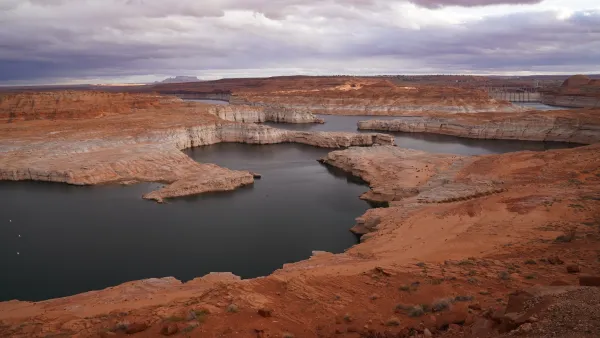
Lake Powell reaches lowest water level on record
Reservoirs along the Colorado River are seeing some of the lowest water flows ever, prompting questions about the future of communities in the basin.

Japan’s bullet trains to debut private pods with 5G wifi windows, “invisible audio bubbles”
The compartments have “personal sound zones” with noise-cancelling technology embedded in the seats, and wifi-infused glass that promises interruption-free streaming and video calls.

Planetizen Federal Action Tracker
A weekly monitor of how Trump’s orders and actions are impacting planners and planning in America.

‘Going backwards:’ Baltimore mayor, students rally against state's transit funding plan
Maryland's proposed six-year plan provides no funding for Baltimore’s BMORE bus program and reduces its road maintenance funding.

Detroit to transform waterfront with $2.2 billion investment
Developers will convert about 18 acres of unused parking lot space into civic spaces.

U.S.-Iran war may have ‘devastating’ impact on cost to warm homes
Vermont and Maine residents may see a 76% increase in the cost of warming their homes this winter.

Senate bill would ‘overhaul’ environmental permitting laws
Under the proposed act, government agencies would also not be able to suspend or rescind permits after granting them.

Exemption applications for NYC’s pied-à-terre tax see 55% success rate
The city sent nearly 40% of its initial pied-à-terre tax warnings erroneously.

FREE Course: Walkable City 1: Why Walkability?
After describing his path towards focusing on walkability as the essence of good planning, Jeff Speck marches through his five principal reasons for making more walkable places.
Reinventing Malls: Planning Alchemy—Turning Gray Fields Into Gold
The course focuses on the opportunities and imperatives that shape reinvention of mall sites.

One Hundred Miles
County of Mendocino
planning NEXT
The Architects Foundation
University of Cincinnati Online
Montrose County
Northern Illinois Transit Authority (NITA)
The Pocatello Development Authority