LA's Metropolitan Transportation Authority has set a toll 'schedule' for solo motorists on the new High Occupancy Toll, or 'ExpressLanes', as the MTA refers to them, on the 10 and 110 freeways. Opening date may be 2010.


As Planetizen reported last month, toll lanes and transit are headed to two Los Angeles County freeways as a consequence of New York City's forfeiting over $300 million in an Urban Partnership Grant when the state assembly did not approve the city's congestion pricing plan last year.
"The introduction of tolls on the 10 Freeway east of downtown Los Angeles and 110 Freeway south of downtown will mark a major departure for roads that generations of Californians have clung to as "freeways," even though toll roads already exist in several parts of the state. Under the pricing schedule, solo motorists will pay 25 cents to $1.40 per mile to travel 14 miles of high-occupancy lanes on the east-west San Bernardino Freeway and 11 miles on the north-south Harbor Freeway.
A solo motorist who wants to use the high-occupancy lanes must enroll in MTA's "ExpressLanes" program and be given a transponder, an electronic device that attaches to windshields and dashboards. When a car uses a toll lane, overhead sensors read the transponder's coding and the motorist is automatically billed."
Thanks to MTC-ABAG Library
Read the full story: MTA changes course, opening carpool lanes to solo drivers -- for a fee

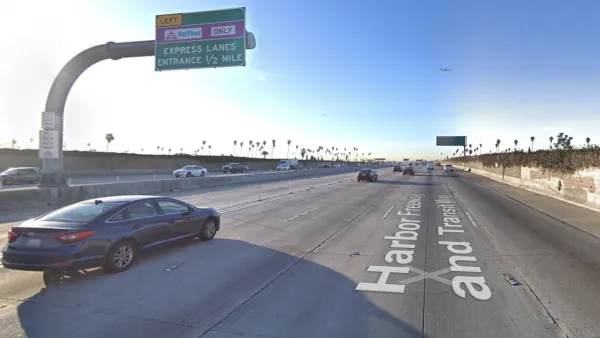
Los Angeles Express Lane Revenue to Fund Electric Double-Decker Buses
Solo drivers who paid a variable toll to use the 10 and 110 freeways in Los Angeles provided $1.4 million to assist in the purchase of the nation's first electric double-decker buses, to be operated by Foothill Transit
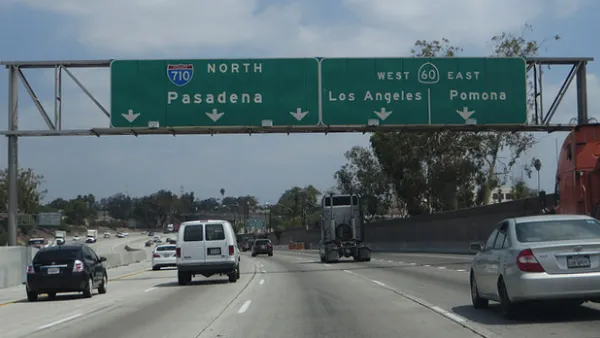
A Traffic Solution 'Straight Out of the 1950s'
That's how the Los Angeles Times editorial board characterized the $6 billion plan by Los Angeles Metro to widen the 710 freeway. "A waste of money," they assert. Key to the solution is how to deal with goods movement from the seaport complex.
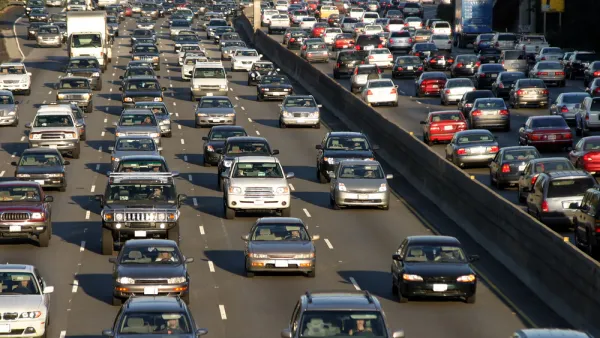
Why Elon Musk Is Wrong about His Boring Solution to L.A.'s Traffic Congestion
Herbie Huff of the UCLA's Lewis Center and Institute of Transportation Studies pens a well-reasoned opinion for the Los Angeles Times as to why a market-based strategy to manage demand is the best approach to traffic congestion in Los Angeles.

Planetizen Federal Action Tracker
A weekly monitor of how Trump’s orders and actions are impacting planners and planning in America.

Amtrak, CN end decades-long dispute with eight-year agreement
The new operating agreement establishes an updated framework for the companies to work together, including processes to resolve disputes.

Judges permit Denver to divert 77,000 acre feet from the Colorado River for reservoir expansion
Overuse and climate change have caused the Colorado River’s water levels to plummet.

NYC DOT wants faster, more permanent street upgrades
The city is examining ways to build more concrete infrastructure without getting entangled in 'decades-long' projects.

'Something we’ve never seen before:' rising utility rates could strain city finances nationwide
Data centers, climate change and other factors have caused utility rates in the United States to increase by 38% since 2020.

Trump to overrule local leaders, lease millions of acres of America’s Pacific Island territories’ seafloors to mining companies
International law says that the Indigenous people of America’s territories have a right to prior and informed consent regarding projects that impact their countries.

FREE Course: Walkable City 1: Why Walkability?
After describing his path towards focusing on walkability as the essence of good planning, Jeff Speck marches through his five principal reasons for making more walkable places.
Reinventing Malls: Planning Alchemy—Turning Gray Fields Into Gold
The course focuses on the opportunities and imperatives that shape reinvention of mall sites.

Harvard University Graduate School of Design
KFH Group Inc.
Greater Baltimore Committee
The Architects Foundation
University of Cincinnati Online
The Pocatello Development Authority
The Urban Renewal Agency of the City of Pocatello