The late columnist Emmett Watson set the tone in Seattle for keeping the small bungalow, suburban character of the city. Today, New Urbanists and others are working to redefine Seattle's landscape post-Watson with denser, affordable buildings.


The local chapter of CORA (Congress for Residential Architecture) is pooling their know-how to define new ways to build density without mimicking the suburban aesthetic already in place.
"In an attempt to make town houses blend in with Craftsman bungalows, Seattle codes created a hybrid, half house and half high-rise, that satisfies no one.
This is not developer greed. It was an earnest attempt by the city and builders to retain the flavor of Seattle's traditional single-family neighborhoods while stuffing in 100,000 more people. Which brings us back to Watson's ghost."
"Do you solve the problem by getting more prescriptive or less?" asks architect John DeForest, another CORA member."
Read the full story: Seattle's 'new urbanism': making smart, sustainable, stylish dwellings
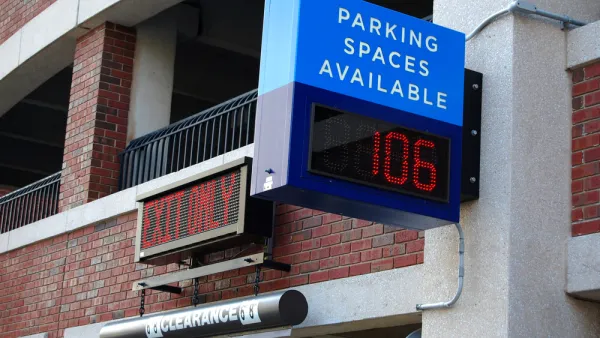
Transit Up, Parking Down in Seattle
Facing an affordability crisis, Seattle is betting on dense, walkable development. The transition away from guaranteed parking promises to be no easier here than elsewhere.
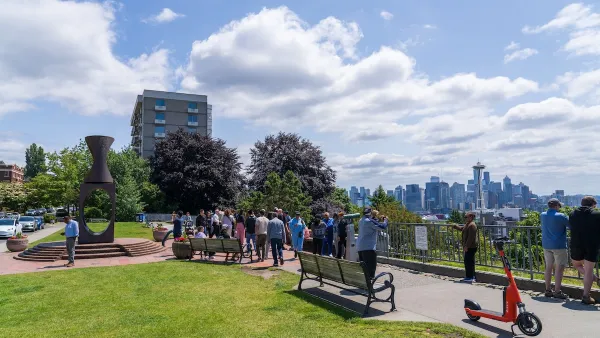
Yet again, Seattle’s density zoning update is hit with delays
The city must now examine the ‘maximum possible development’ under a future zoning scenario, rather than the ‘maximum likely development.’
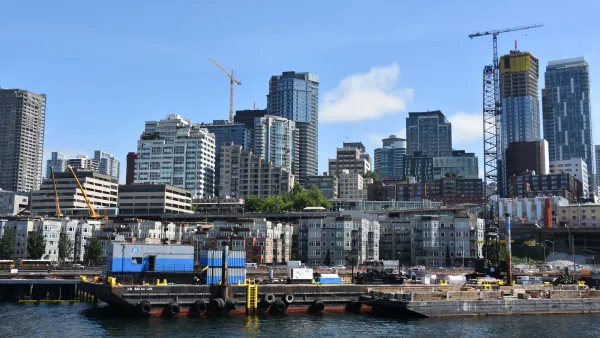
Seattle upzoning proposal seeks to boost density, support eco-friendly building materials
A city committee advanced the plan to target areas already open to multifamily development for additional density and encourage passive house and mass timber construction.

Desperate measures: Advocates weigh draining Lake Powell to fill Colorado River
Draining the reservoir could reduce evaporation losses by a couple hundred thousand acre-feet.

Eastern Nebraska is running out of electricity
Data centers and electrification are straining eastern Nebraska’s grid, throttling economic development.

Malls are becoming the midtowns of the future
Mall and office park redevelopments are a generational opportunity to create new nodes of urbanity.

NYC breaks ground on anti-flooding infrastructure project
New York City's new system will reduce stormwater flows to local sewers by 90%.

One Kentucky town’s secret to affordable housing
The Smoketown Community Land Trust has already built seven affordable homes for community members.

Houston gains petal-shaped cooling infrastructure to make streets more ‘delightful’
The city has installed the pavilions along 15 blocks in Houston.

FREE Course: Walkable City 1: Why Walkability?
After describing his path towards focusing on walkability as the essence of good planning, Jeff Speck marches through his five principal reasons for making more walkable places.
Reinventing Malls: Planning Alchemy—Turning Gray Fields Into Gold
The course focuses on the opportunities and imperatives that shape reinvention of mall sites.

City of Rosemead
Rutgers University, Edward J. Bloustein School of Planning and Public Policy
One Hundred Miles
University of Michigan School for Environment and Sustainability (SEAS)
Hunter College, City University of New York (CUNY)
The Architects Foundation
City of Cambridge
Montrose County
The Pocatello Development Authority