Alex Marshall takes a look at Spain's recent record of proactive transportation planning, connecting cities to direct development rather than to connect already successful areas.


"Spain, eyeing the fast trains in France in the early 1990s, opted to build its first high-speed rail line from Madrid to Seville, a beautiful city of Moorish architecture and Flamenco dancers, but not an economic dynamo.
Many thought a better choice would have been to build it between Madrid and the thriving city of Barcelona. Many businessmen already made that journey, and many wanted to do so more quickly and easily.
I rode the new Seville line in 1994, shortly after it opened. I made the 300-mile trip from Madrid to Seville in less than two hours, visiting the Seville World's Fair and returning to Madrid in time for dinner. Even so, I wondered at the wisdom of making Madrid-Seville the first line in the system.
But over the past 17 years, the line to Seville has jump-started the economy not only of that city but of an entire region of the country, beautiful but struggling Andalucia. And once the rest of Spain saw how well high-speed train travel worked, the network was expanded, to Barcelona and other major cities, as well. There are predictions that by 2020, nine-tenths of the country's population will be living within about 30 miles of a high-speed train connection."
Read the full story: A Bridge to Somewhere


Brightline West Moves Forward With Finalized Federal Funding
The high-speed rail line will connect Southern California and Las Vegas via a two-hour trip along Interstate 15.
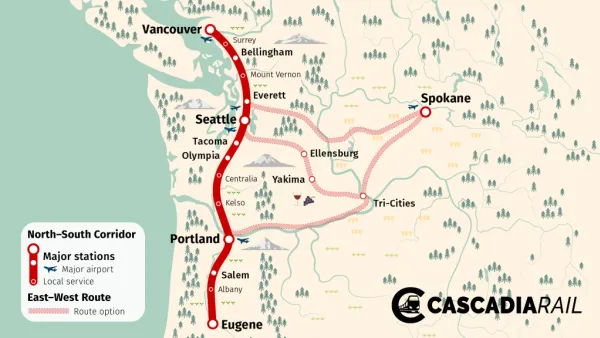
Cascadia High-Speed Rail Corridor Seeking Federal Funding
The state of Washington is hoping federal infrastructure funding can pay for $198 million of the $348 million necessary to plan the Cascadia High-Speed Rail project.
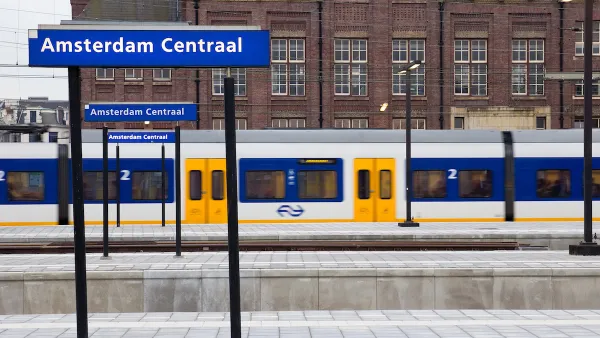
Eurostar Temporarily Closing Two High-Speed Rail Routes
Eurostar is temporarily closing routes from London to Disneyland Paris and London to Amsterdam.

Planetizen Federal Action Tracker
A weekly monitor of how Trump’s orders and actions are impacting planners and planning in America.

Chicago breaks ground on $3 billion megadevelopment
The new neighborhood, titled Foundry Park, will one day host 3,700 residences.

This MA town is drowning in its own sewage — and residents like it that way
Susan Murcott, a waste water expert, said if Carlisle didn't address their leaking sewage, the problem could turn “deadly.”

Iowa taxpayers are paying thousands to clean manure out of their water
While the Clean Water Act makes states responsible for regulating factory farms that discharge pollutants, Iowa has turned a blind eye to the polluting farms.

Amtrak cuts ribbon on Seattle Airo maintenance facility
The $250 million, nearly 100,000-square-foot building can house an entire Cascades Airo trainset.

To power data centers, Google seeks autonomous control of thousands of homes’ electricity
The tech company has signed a deal to indirectly pay Mid-Atlantic residents to reduce their power demand when the grid is strained.

FREE Course: Walkable City 1: Why Walkability?
After describing his path towards focusing on walkability as the essence of good planning, Jeff Speck marches through his five principal reasons for making more walkable places.
Reinventing Malls: Planning Alchemy—Turning Gray Fields Into Gold
The course focuses on the opportunities and imperatives that shape reinvention of mall sites.

City of Rosemead
Rutgers University, Edward J. Bloustein School of Planning and Public Policy
One Hundred Miles
The Architects Foundation
University of Cincinnati Online
Montrose County
The Pocatello Development Authority
The Urban Renewal Agency of the City of Pocatello