This piece from Utne Reader looks at Ecuador's recent extension of inalienable rights to nature and why other countries should follow this lead.


"In September 2008, the citizens of Ecuador approved the world's first constitution to extend inalienable rights to nature. In the South American country, "Nature, or Pachamama . . . [now] has the right to exist, persist, maintain and regenerate its vital cycles, structure, functions and its processes in evolution."
Ecuador's policy makers received assistance structuring the groundbreaking eco-provisions from the Community Environmental Legal Defense Fund (CELDF), a U.S.-based nonprofit that's helped municipalities in several U.S. states enact similar "right of nature" laws. The concept is simple but inspired: Give nature rights, so that people can defend them-instead of going after eco-violators for bureaucratic infractions.
Most contemporary law treats nature as property and favors the proprietor, merely limiting the destruction of nature, rather than prohibiting it for nature's own sake."
Read the full story: The Emancipated Earth

Nature Gains Constitutional Rights in Ecuador
A new constitution has been approved in Ecuador, and among its amendments are specific articles that grant inalienable rights to nature.

Once a year, Maine roads become highways for amphibians
The 'Big Night' brings out volunteers to help frogs, salamanders, and other migrating amphibians cross roads to reach their breeding grounds.

San Diego Sues DHS, DOD Over Razor Wire Near Mexico Border
The city says U.S. Marines trespassed on city land to install fencing that damages sensitive habitat in an area designated as conservation land.

Planetizen Federal Action Tracker
A weekly monitor of how Trump’s orders and actions are impacting planners and planning in America.

Northwest rail fans eager for Sept. 30 debut of Amtrak’s Airo fleet
Get ready for that new train smell and more seats. But they won’t go faster or run more frequently on the Cascades route in Washington and Oregon.
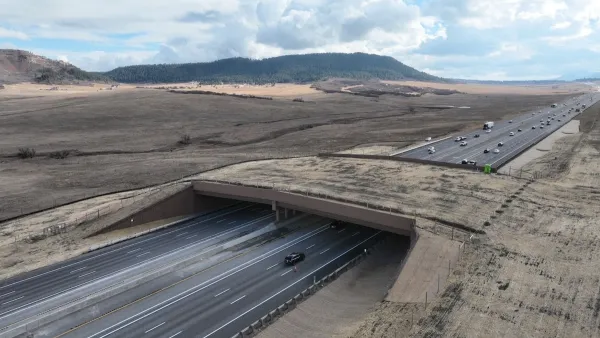
Record-breaking wildlife overpass in Colorado brings 91% reduction in animal collisions
Prior to the overpass, vehicles were hitting one deer per day on Colorado’s Interstate 25.

Detroit to transform waterfront with $2.2 billion investment
Developers will convert about 18 acres of unused parking lot space into civic spaces.

‘Going backwards:’ Baltimore mayor, students rally against state's transit funding plan
Maryland's proposed six-year plan provides no funding for Baltimore’s BMORE bus program and reduces its road maintenance funding.

Trump wants to cancel nearly 98% of funding for HUD housing support program
Multiple housing groups are suing the administration in an effort to preserve the funding.

FREE Course: Walkable City 1: Why Walkability?
After describing his path towards focusing on walkability as the essence of good planning, Jeff Speck marches through his five principal reasons for making more walkable places.
Reinventing Malls: Planning Alchemy—Turning Gray Fields Into Gold
The course focuses on the opportunities and imperatives that shape reinvention of mall sites.

City of Thousand Oaks
City of Wisconsin Rapids
Harvard University Graduate School of Design
The Architects Foundation
University of Cincinnati Online
Northern Illinois Transit Authority (NITA)
The Pocatello Development Authority
The Urban Renewal Agency of the City of Pocatello