





















The effects of the U.S. Green Building Council's new LEED-ND certification for neighborhoods leaves plenty of questions to be answered regarding its effects (intended or not) on land use, sprawl, and property values.


"Not only will there likely be a certain cachet associated with LEED-ND neighborhoods, the USGBC foresees certain tangible benefits to developer, namely local governmental incentives such as reduced fees or shorter development permit waiting periods. Among the intangible benefits stated by the USGBC, "leaving a good impression on your neighbors" illustrates the desire of the USGBC to influence the surrounding urban fabric.
The tenets of LEED-ND are not new, however. A resurgence of interest in traditional urban design principles led to a movement in the 1990s that redefined urban planning in the United States - new urbanism and neo-traditional neighborhood development. The new urbanism and neo-traditional town planning concepts were heralded by influential members of the urban planning community, and such concepts were transformed into reality by aesthetically pleasing developments such as Seaside and Celebration in Florida, Kentlands in Maryland and numerous other variations and adaptations throughout the United States. New urbanism was a reaction to suburban sprawl and irresponsible development patterns of the previous 50 years. Its focus was largely on new self-contained green-field developments in exurban areas."
FULL STORY: Certifying place with the new LEED-ND designation


Planetizen Federal Action Tracker
A weekly monitor of how Trump’s orders and actions are impacting planners and planning in America.
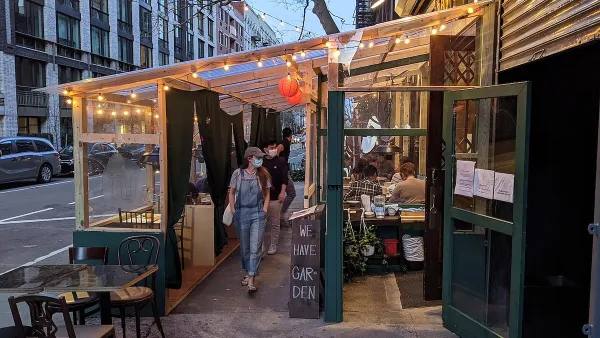
Restaurant Patios Were a Pandemic Win — Why Were They so Hard to Keep?
Social distancing requirements and changes in travel patterns prompted cities to pilot new uses for street and sidewalk space. Then it got complicated.

Maui's Vacation Rental Debate Turns Ugly
Verbal attacks, misinformation campaigns and fistfights plague a high-stakes debate to convert thousands of vacation rentals into long-term housing.

Boulder Eliminates Parking Minimums Citywide
Officials estimate the cost of building a single underground parking space at up to $100,000.

Orange County, Florida Adopts Largest US “Sprawl Repair” Code
The ‘Orange Code’ seeks to rectify decades of sprawl-inducing, car-oriented development.

Maui's Vacation Rental Debate Turns Ugly
Verbal attacks, misinformation campaigns and fistfights plague a high-stakes debate to convert thousands of vacation rentals into long-term housing.

Urban Design for Planners 1: Software Tools
This six-course series explores essential urban design concepts using open source software and equips planners with the tools they need to participate fully in the urban design process.
Planning for Universal Design
Learn the tools for implementing Universal Design in planning regulations.

Heyer Gruel & Associates PA
JM Goldson LLC
Custer County Colorado
City of Camden Redevelopment Agency
City of Astoria
Transportation Research & Education Center (TREC) at Portland State University
Camden Redevelopment Agency
City of Claremont
Municipality of Princeton (NJ)