The Wall Street Journal asked four architects (including William MacDonough and Steve Mouzon) to design an energy-efficient, sustainable house of the future. The results are in, and couldn't be more different.


"'I'd love to build a house like a tree,' says architect William McDonough of the Charlottesville, Va., firm William McDonough + Partners. And that's what he set out to do here.
The surface of his house, like a leaf, contains a photosynthetic layer that captures sunlight. Unlike today's solar panels, which are often pasted above a roofline, these are woven into the fabric of the exterior. They heat water and generate electricity for the home -- and create oxygen for the atmosphere, to offset carbon produced in other areas of the home.
The appeal of ultrathin, integrated solar panels goes beyond convenience. Today's solar is plain ugly and off-putting to many homeowners, something Mr. McDonough calls the 'potpourri of miscellany stuck on our roofs.' Unseen solar arrays, especially ones that create hot water, will be a 'breakthrough from aesthetic perspective, which is a huge issue,' he says."
Read the full story: The Green House of the Future

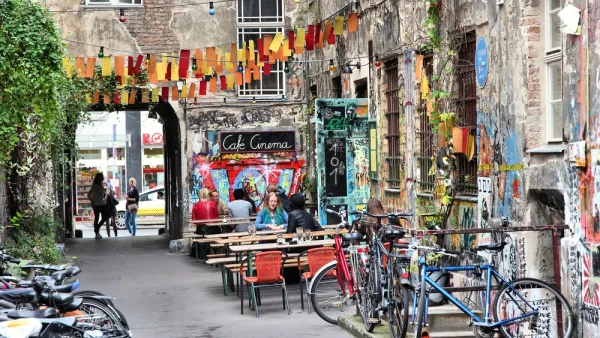
Lessons Learned from Berlin Shopfronts
Susan Henderson looks to Berlin's delectable shopfronts for pointers. Not from the usual suspects like Kurfürstendamm and Friedrichstrasse, but from the neighborhoods of Prenzlaur Berg, Scheunenviertal, Kreuzberg, and of course, Hackeschen Höfe.
Embodied Energy of Historic Buildings: Physical and Metaphysical
Inherently unlovable buildings—no matter how energy efficient—lacks the stuff of longevity. How can your EcoDistrict design for lovable buildings? It may not include tearing down the historic stock.
New Book Delivers Lessons for Utilizing New Media
Are your marketing strategies in need of a "New Media" refresh? Steve Mouzon's new e-book, New Media for Designers + Builders gets two thumbs up from Susan Henderson and Hazel Borys.

Planetizen Federal Action Tracker
A weekly monitor of how Trump’s orders and actions are impacting planners and planning in America.

‘Going backwards:’ Baltimore mayor, students rally against state's transit funding plan
Maryland's proposed six-year plan provides no funding for Baltimore’s BMORE bus program and reduces its road maintenance funding.

Record-breaking wildlife overpass in Colorado brings 91% reduction in animal collisions
Prior to the overpass, vehicles were hitting one deer per day on Colorado’s Interstate 25.

Mamdani sent nearly 6,000 pied-à-terre tax warnings to homes that didn’t qualify
A judge has ordered the administration to cancel thousands of pied-à-terre tax notices after it sent 35% of them erroneously.

Detroit to transform waterfront with $2.2 billion investment
Developers will convert about 18 acres of unused parking lot space into civic spaces.

‘Going backwards:’ Baltimore mayor, students rally against state's transit funding plan
Maryland's proposed six-year plan provides no funding for Baltimore’s BMORE bus program and reduces its road maintenance funding.

FREE Course: Walkable City 1: Why Walkability?
After describing his path towards focusing on walkability as the essence of good planning, Jeff Speck marches through his five principal reasons for making more walkable places.
Reinventing Malls: Planning Alchemy—Turning Gray Fields Into Gold
The course focuses on the opportunities and imperatives that shape reinvention of mall sites.

City of Thousand Oaks
City of Wisconsin Rapids
Harvard University Graduate School of Design
The Architects Foundation
University of Cincinnati Online
Northern Illinois Transit Authority (NITA)
The Pocatello Development Authority
The Urban Renewal Agency of the City of Pocatello