




















How Does Maglev Work, Anyway?
17 March 2009 - 6:00am
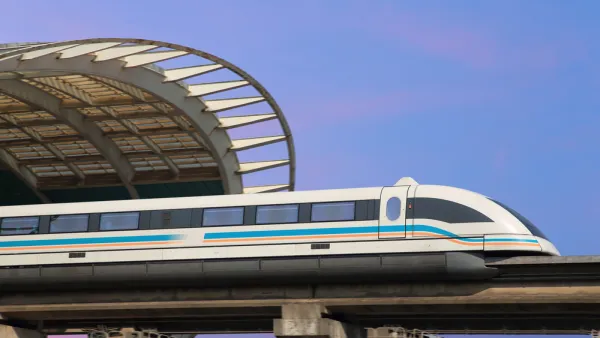
A new sixty-minute TV documentary explains how maglev technology works, and covers the first major accident on a maglev track.
"The secrets and the science behind engineering and constructing the world's fastest train: The Shanghai Maglev." (VIDEO)
Full Story:
MAGLEV
Source:
Parallax Film Productions, March 16, 2009
»
- Login or register to post comments
- Email this page
- HSR Too Slow? Blame CEQA - Nov 19, 2009
- All Eggs in the HSR Basket - Nov 16, 2009
- HSR Can't Come Fast Enough - Nov 12, 2009
- Proactive Vs. Reactive Transportation Planning - Jun 03, 2009
- Playing Catch-Up with Rail - Mar 19, 2009
“
The areas where we have severe blight and indications of more blight to come are basically the same as they ever were. How in the world are we ever going to move our community development selves into an alternative future that thinks differently about the challenges we face in our cities and low-income suburban and rural communities?
”


actually.... no
First of all, its a Stabalized Permanant Magnet system, meaning that it requires no energy for levitation, unlike the superchared magnets of the transrapid.
Second of all, the fact that it can be integrated with existing rail infrastructure is exactly what makes this system more practical, because no new rights of way need to be acquired.
A full scale test tracl is under construction, but several prototypes have already been tested with excellent results. All it needs is full funding and it will easily bypass the transrapid.
We can pretty well know how much power each system will use
Larry,
My Swiss watch keeps very accurate time, but that doesn't stop it from being an antique.
The Transrapid design was state-of-the-art when it was designed -- about four decades ago. Of course elements of the design have been improved since then -- but it's still an electromagnetic suspension (EMS) system using long-stator linear synchronous motors. The significant electromagnetic drag that such a system creates is not an opinion, it is an unavoidable reality.
Since both electrodynamic systems and permanent magnet systems have lower drag than EMS systems, they will generally use less power then EMS systems such as Transrapid. No one has identified any aspect of our technology that would suggest that we will use more power than Transrapid.
In fact, in the interest of full disclosure, we should note that I have repeatedly invited you to visit the LaunchPoint engineers' shop and review the technical backup to the prototypes. You have not done so. So I don't know what basis you have to dispute the claim that our vehicles will use less power than Transrapid vehicles.
To use another analogy, you're entitled to say (as you have said) that a jet plane isn't "proven" until it's flown successfully. But it's a different thing to say (as you have also said) that it's just an "opinion" that the jet plane will fly faster than a propeller plane.
Best personal regards,
Andrew
Andrew Hayes
Fastransit Inc.
1 Rockefeller Plaza, Suite 1005
New York, NY 10020
ahayes@fastransitinc.com
The transrapid is not antiquated technology
Sorry, jackson92186, your points against Transrapid are ill-informed and don't hold water. It's your opinion, not a fact, that Transrapid is antiquated. And while you may be enamored with the new (unproven) Fastransit approach, you can't discount the commercial service status and positive performance of Transrapid in Shanghai over the past six years. It'll be many years before Fastransit can boast of its commercial service performance anywhere.
To carry on: In fact, Transrapid's track switches are properly sized for the system's size and speed requirements and require 30 seconds, not several minutes, to operate. And, for now, nobody knows if Fastransit will be much less costly to build than Transrapid, or if it will use less energy, much less if it will have "all of the benefits of speed and low operating costs." Further, any concept that aims to be "integrated with existing rail infrastructure while not interfering with conventional trains" has its mission confused. All these items --- and many more -- remain to be demonstrated.
http://www.maglevtransport.com
The transrapid is in fact
The transrapid is in fact antiquated maglev technology. I urge anyone interested to look at this website: www.fastransitinc.com
There you will see a new, American design which can be integrated with existing rail infrastructure while not interfering with conventional trains. And unlike the transrapid, which has huge track switches houndreds of feet long and several minutes to operate, the SPM system has fixed switches--no moving parts--which allows instantaneous switching.
On top of that, it is much less costly to build and uses even less energy than the transrapid, with all of the benefits of speed and low operating costs.
This is the future of transportation.